A terminal automation system is what stands between a tank farm full of product and a truck leaving the gate with the right volume, paperwork, and entry in your enterprise resource planning (ERP) systems. It is also one of the largest capital commitments a terminal operator makes. According to Future Market Insights, the oil and gas terminal automation market was worth around $1.6 billion in 2025 and is forecast to reach $3.4 billion by 2036, growing 7.2% a year.
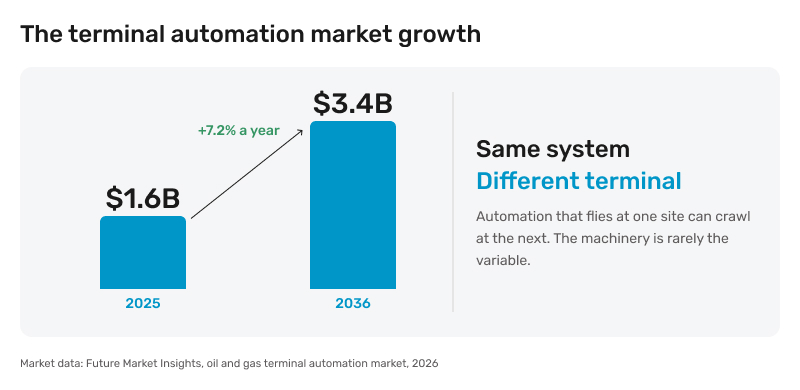
Here’s the awkward bit: automation is supposed to boost terminal productivity, but it might do the opposite. The technology itself clearly works, because the same system can fly at one terminal and crawl at another. So maybe the problem isn’t the shiny new machinery after all; maybe it’s the operation it was dropped into.
Which is why this blog post looks at terminal automation through the lens of simulation modeling. The technology that lets you build a replica of your terminal and run the automation design against real patterns and failures.
Contents:
- What is a terminal automation system?
- How terminal automation works and how to model it
- How simulation modeling works for terminal automation
- Getting terminal management right before you automate
- FAQ
- Use AnyLogic for your business
What is a terminal automation system?
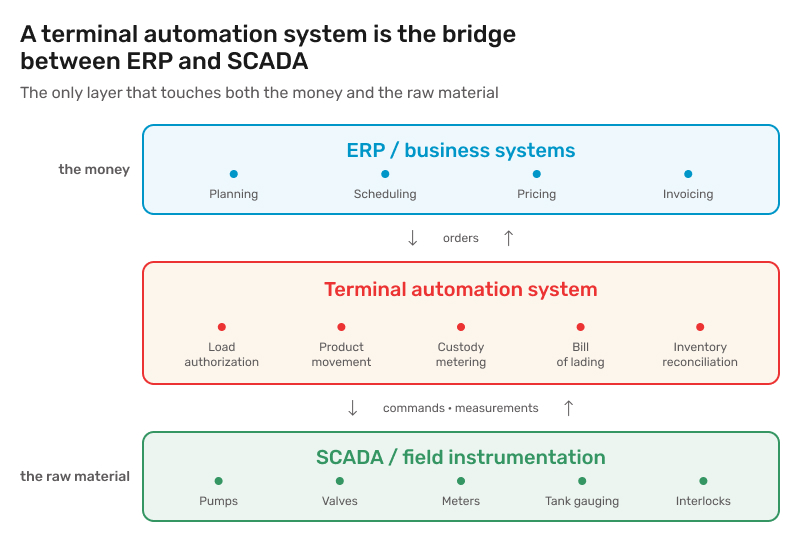
A terminal automation system (TAS) is the control and integration layer at a bulk liquid terminal. It connects field instrumentation, metering, and safety devices to process control and business systems, automating numerous processes, including:
- Driver, vehicle and carrier validation, and load authorization.
- Truck, rail car, and marine and pipeline loading and unloading.
- Additive injection, blending, tank gauging, and real-time inventory.
- Custody-transfer metering, bill of lading generation, and ticketing.
- Gate and access control.
- Inventory reconciliation, loss/gain, and multi-owner custody accounting.
- Data exchange with ERP.
The shortest, useful description of where it sits: a terminal automation system is the bridge between ERP and supervisory control and data acquisition (SCADA) systems. It translates commercial orders into physical, measured, legally documented product movements—the only layer in terminal operations that touches both the money and the raw material.
Terminal automation is most established in downstream oil and gas (fuel depots, tank farms, and chemical and LPG terminals), but the same architecture now appears at biofuel, methanol, and ammonia facilities as terminals diversify.
How terminal automation works and how to model it
Terminal automation systems are built as a layered stack. The right-hand column shows what each layer becomes inside a simulation model.
| Level | Layer | In the real terminal | In the model |
|---|---|---|---|
| 0 | Process | Loading arms and pumps, valves, grounding verification, overfill protection | Equipment capacity, transfer rates, loading and unloading times |
| 1 | Measurement & control | Flow meters, preset and batch controllers, safety PLC, card readers | Service-time distributions, meter and bay failure rates, repair times |
| 2 | Supervisory control | SCADA and DCS, tank gauging, alarm management, tank farm monitoring | Tank levels, changeover rules, product availability |
| 3 | Terminal management | Orders, load authorization, compartment allocation, blend recipes, gate and queue management, bill of lading | The decision logic under test: dispatch rules, bay assignment, queue discipline, appointment windows |
| 4 | Business / ERP | Planning, scheduling, pricing, invoicing | Demand profiles by hour, day, and season; product mix; growth scenarios |
Some of these layers behave very differently, and the difference is the whole argument for modeling.
- Levels 0 and 1 are expensive to change. Pumps, loading arms, and meters are physical equipment, and the metering must be officially certified, because every load is a custody transfer that gets taxed and invoiced. Adding a bay or swapping a rack later means real money and downtime.
- Level 3 is free to change. Which truck goes to which bay, in what order, under which rules—that is software. You can rewrite it as many times as you like.
- Levels 2 and 4 are inputs, not decisions. Tank levels, product availability, and the demand coming from your order book are the conditions the terminal must cope with. The model takes them as given and tests how the other layers hold up.
So, the question worth answering before you buy simulation software (for example AnyLogic) is simple: which layer is my bottleneck actually in?
Terminals routinely spend on new hardware when the constraint was a loading rule all along. Simulation helps identify the difference by letting you test process changes and equipment upgrades before committing capital.
How simulation modeling works for terminal automation
Spreadsheets fail here for a specific reason: nothing about terminal operations is average. Truck arrivals are clustered. Product demands are interdependent. Equipment fails. Congestion is emergent, not additive.
When Wolverine Terminals planned a new marine fueling service in Canada, there was no historical operating data to rely on. A discrete-event simulation model helped the team stress-test the terminal under different demand, supply, processing, and environmental conditions, identify bottlenecks, and validate how much throughput the proposed system could handle before operations began.
The methods
No single modeling method captures an entire terminal. With AnyLogic you can combine multiple approaches in one connected model:
- Discrete-event modeling represents workflows, queues, resource allocation, loading, and gate-out.
- Agent-based modeling captures how trucks, drivers, and equipment behave and interact, revealing how congestion emerges.
- System dynamics links operational performance with demand, seasonality, investment decisions, and long-term capacity.
The methods reinforce one another. Demand drives activity, individual behaviors shape congestion, and congestion affects terminal-wide performance.
What you run
A model does more than give you one answer. It lets you test different scenarios and understand how the system behaves under changing conditions.
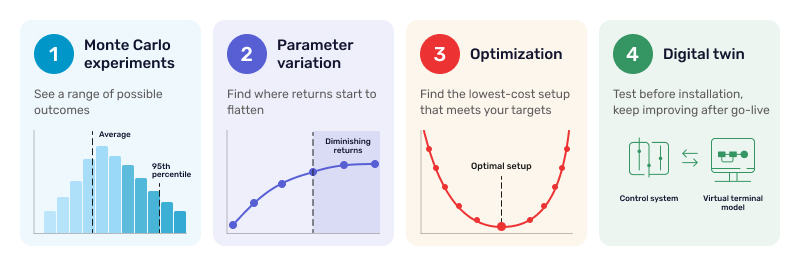
Monte Carlo experiments run the same scenario many times, helping you plan for realistic peaks instead of relying only on average results. Parameter variation tests different numbers of bays, meter rates, and shift patterns to show where extra investment stops delivering meaningful gains. Optimization helps find the lowest-cost setup that still meets your service targets.
You can connect real control systems to the virtual terminal to test automation software before installation, then use the same model as a digital twin after go-live to improve dispatch rules, test changes, and plan future lines.
What it finds
What comes back is rarely what the business case assumed. More often than not, a model finds capacity the terminal already owns but cannot see.
Port Botany is a clear example. Under pressure to lift rail's share of container movements from 15% to 40%, the model of its rail operations found 20% more capacity from operational changes alone and a further 120% available by resolving a single shunting bottleneck.
The constraint is rarely the equipment itself. It is how the equipment is being used.
Across AnyLogic terminal projects, a model tends to bring to the surface one of three things:
- A cheaper answer than the one you were about to buy. A berth capacity study facing an 80% volume surge found ways to raise output with no capital spend at all.
- Capital you do not need to commit. An oil pipeline and terminal network model identified $50–80 million of avoidable investment on a $3 million modeling spend.
- Evidence for a decision you cannot otherwise justify. At Le Havre, autonomous rail cars beat conventional ones on cost and efficiency before anything was ordered; the model became the investors' feasibility evidence.
The model does not stop at the decision, either. At Terminal San Giorgio the yard digital twin went on to train an AI truck-allocation policy that matched experienced managers and lifted throughput 20%.
If you are looking for the latest cases of using simulation modeling for terminal optimization, check out the presentations from the AnyLogic Conference 2026.
Getting terminal management right before you automate
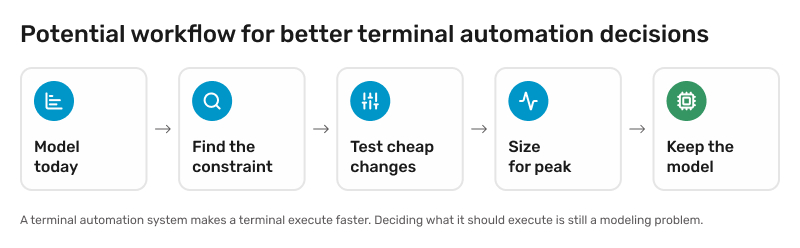
- Model the terminal as it runs today, validated against your historical throughput. If the model can't reproduce last year, it can't predict next year.
- Find the real constraint before choosing what to automate. It is often not the equipment you were about to buy.
- Test the cheap changes first: queue policy, dispatch rules, bay assignment, and appointment windows.
- Size the automation against peak and disruption, not the average.
- Keep the model after go-live as the digital twin you can use to tune the system and plan the next product line.
A terminal automation system makes a terminal execute faster. Deciding what it should execute is still a modeling challenge.
FAQ
What is terminal automation?
Terminal automation is the practice of replacing manual terminal operations with automated equipment and control systems. At a bulk liquid terminal, that means automated loading, metering, and documentation; at a container terminal, automated cranes, stacking, and horizontal transport. The terminal automation system is the control and software layer that runs it.
How does a terminal automation system improve supply chain efficiency?
By making terminal operations predictable, not just faster. Unattended loading extends operating hours, automated gates and documentation cut truck turnaround, and real-time inventory gives ERP and downstream planning accurate data. Carriers can schedule tighter, and shippers can see true stock positions. The gains are site-specific: the same terminal automation system performs very differently depending on layout, arrival pattern, and where the bottleneck sits.
What are the key features to look for in terminal operating systems?
Yard and vessel planning, real-time cargo inventory, equipment control integration, automated gate handling with OCR and RFID, EDI and API connectivity to carriers and customers, billing, and configurable job-allocation rules.
What are the latest trends in terminal automation technology?
Five stand out. Digital twins fed by live data from terminal operations. AI and predictive analytics for maintenance, demand forecasting, and dispatch. Cloud and web-based terminal management replacing on-premises installs. Electrification of terminal equipment, which adds battery charging as a scheduling constraint that did not exist before. And the energy transition—terminals taking on biofuels, methanol, and ammonia now need multi-product blending and segregation logic that single-product systems were never specified for. Most spending now goes to brownfield retrofits rather than greenfield builds.
Use AnyLogic for your business
AnyLogic is the simulation modeling technology behind terminal, port, and oil and gas projects worldwide. It is the only platform combining discrete-event, agent-based, and system dynamics modeling in one environment, with dedicated libraries for fluid handling, material handling, and road traffic.
Model your terminal before you automate it, and find out what the investment is worth while it is still reversible.