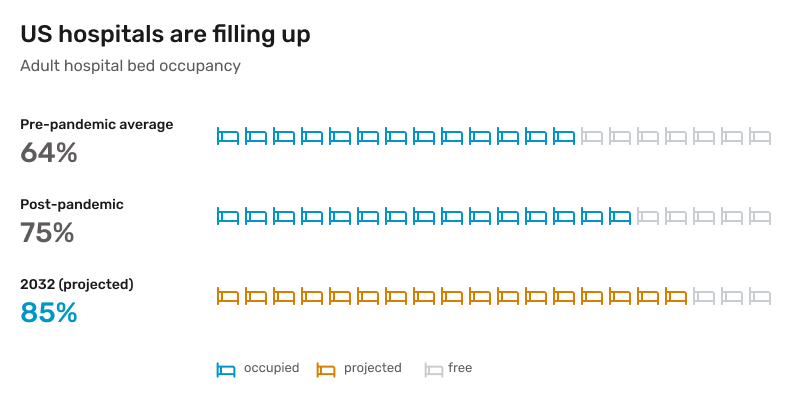
Predictive analytics in healthcare has never mattered more. Hospitals have more data than ever, and less room for error. US hospital occupancy averaged about 64% in the decade before the pandemic. It now sits near 75%, and researchers project it could reach 85% by 2032 if staffing and bed supply stay flat.
So it’s no surprise that healthcare predictive analytics is one of the fastest-growing corners of health IT. BCC Research values the market at $16.7 billion in 2025 and expects it to reach $50.4 billion by 2030, growing 24.7% a year. But a forecast only tells you what will probably happen. It doesn’t tell you what to do about it. If the model says your emergency department will overflow next Tuesday, should you add a physician, open ten beds, or change discharge times? That question needs a different kind of model.
This post covers what predictive analytics in healthcare is, where AI-only prediction falls short, and how simulation turns forecasts into tested decisions. It also shows how to get started with AnyLogic Desktop and AnyLogic Online.
Contents:
- What is predictive analytics in healthcare?
- Predictive modeling in healthcare analytics with simulation
- AnyLogic Desktop and AnyLogic Online
- Benefits for providers, insurers, and public health
- FAQ
- Use AnyLogic for predictive modeling in healthcare analytics
What is predictive analytics in healthcare?
Predictive analytics in healthcare uses historical and real-time data to estimate what is likely to happen next: to a patient, a ward, a hospital, or a whole population. Typical inputs are electronic health records (EHR), claims, lab results, admission logs, and staffing rosters. Typical outputs are a risk score, a demand forecast, or an early warning.
Adoption is already mainstream. According to the ONC, 71% of US hospitals used predictive AI integrated with their EHR in 2024. Most of it still points at the patient, not at the system around the patient.
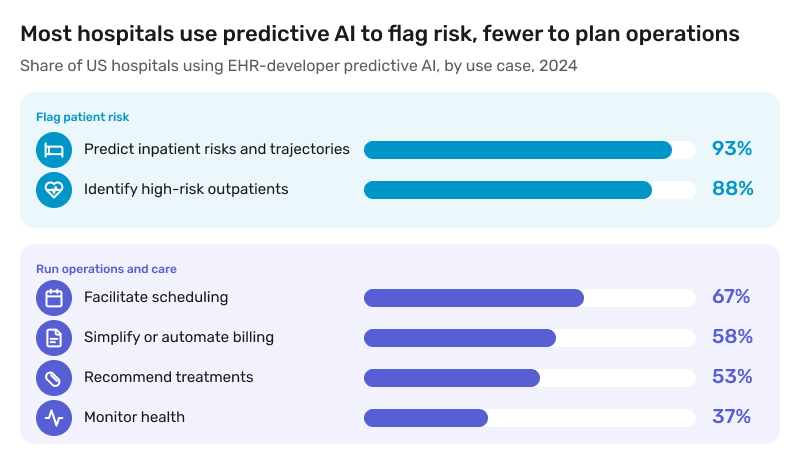
Hospitals are no longer using predictive AI just to flag sick patients. They’re using it to run the business: who to schedule, when to bill, and how much capacity to plan for. But operational forecasts raise a harder question than clinical ones. Knowing the emergency department will be busy next week is only useful if you also know which response will actually work. That is the gap most predictive tools leave open.
Where AI-only prediction falls short
Most healthcare predictive analytics today runs on machine learning. It is excellent at spotting patterns in large datasets, and it’s the right tool for many clinical risk scores. But it also has limits that matter for anyone running a hospital or a health plan.
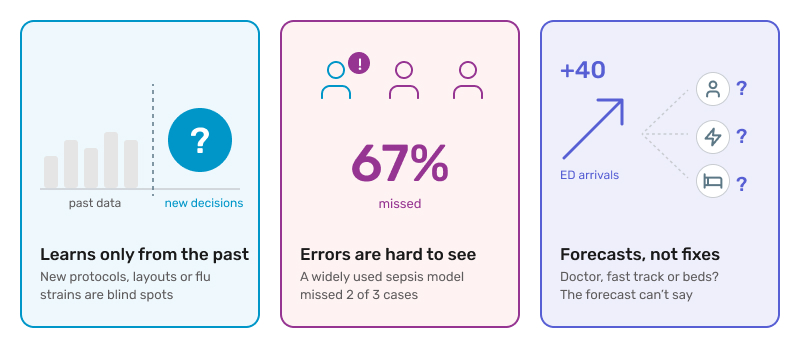
It learns from the past, so it struggles with the new. An AI trained on last year’s admissions has never seen your new protocols, a new ward layout, or next winter’s flu strain. Ask it about a decision you’ve never made, and it has no data to answer from.
It can be wrong in ways that are difficult to see. When researchers externally validated a widely used proprietary sepsis model on 27,697 patients, it missed 1,709 of the 2,552 sepsis cases, or 67%.
It predicts, but it doesn’t prescribe. A forecast of 40 extra emergency department arrivals is useful. However, it doesn’t tell you whether another physician, a fast-track zone, or ten more beds is the better fix.
This is where predictive modeling in healthcare analytics suits better. A simulation model isn’t built only from correlations in data. It recreates how the system actually works: patients arriving, triage rules, beds, staff shifts, and discharge processes. You can then change any of those and watch what happens, including scenarios that have never occurred. Clinicians can see the model’s logic play out as an animation, which makes it far easier to trust than a black-box score.
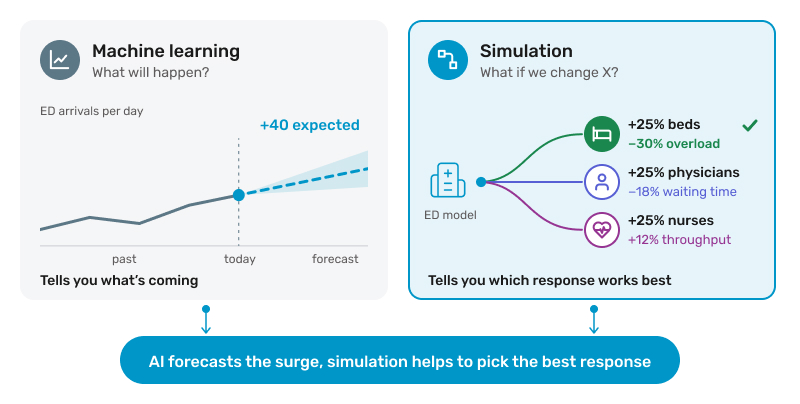
The strongest approach combines both. Machine learning forecasts demand or patient risk, and the simulation tests how the hospital should respond. Simulation can also generate synthetic data to train AI where real data is scarce or sensitive.
Learn how leading organizations combine machine learning with simulation. Download the Artificial Intelligence and Simulation white paper.
Predictive modeling in healthcare analytics with simulation
Simulation-based predictive modeling uses three methods, and real healthcare problems usually need more than one:
- Discrete-event simulation models processes: patient flow through the emergency department, operating room scheduling, and lab and pharmacy queues.
- Agent-based modeling gives each patient, clinician, or facility its own behavior: no-shows, disease progression, or care choices.
- System dynamics captures big-picture feedback loops: population health, workforce pipelines, and policy and funding.
AnyLogic lets you combine all three methods in a single model and plug machine learning straight into it. Here’s what that looks like in practice.
Testing emergency department surge plans before the surge. Researchers built an AnyLogic model of an emergency department, validated with clinicians from a UAE hospital. Under surge demand, waiting times rose 60%. The model then tested three fixes before anyone spent a dollar.
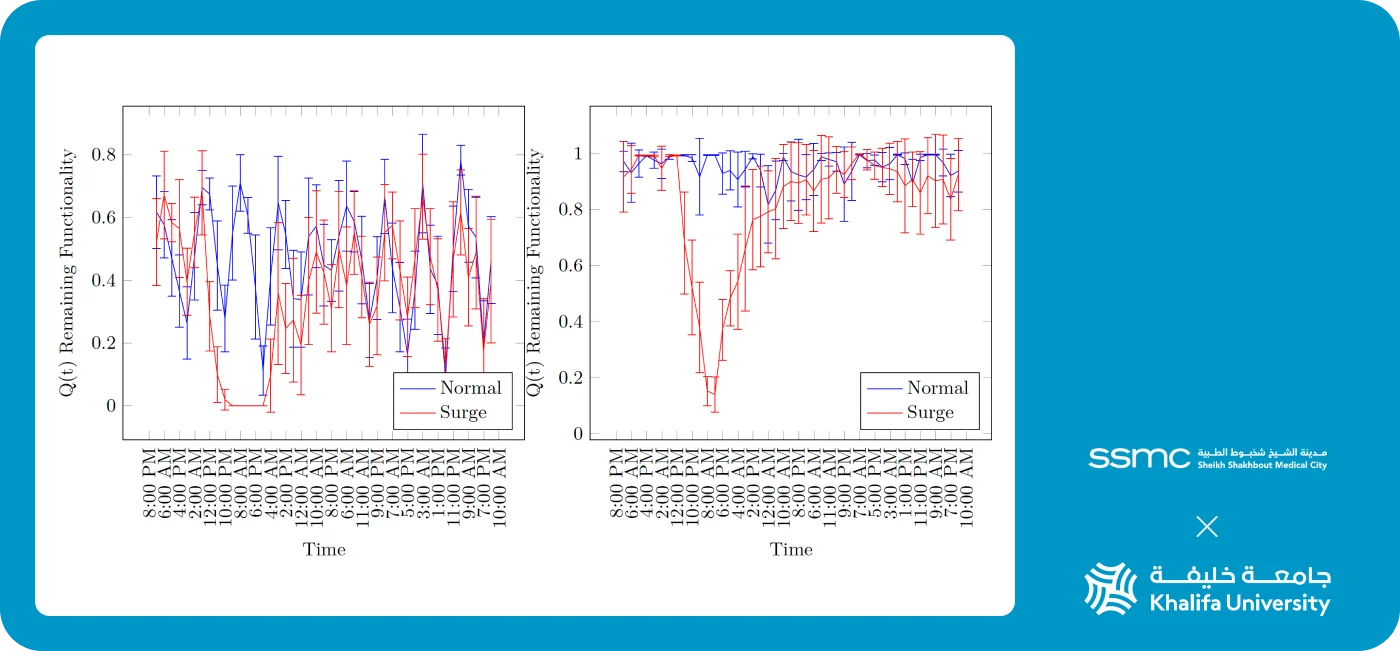
A machine learning model could have predicted the surge. The simulation showed which response would work best: beds, not extra staff, made the biggest difference.
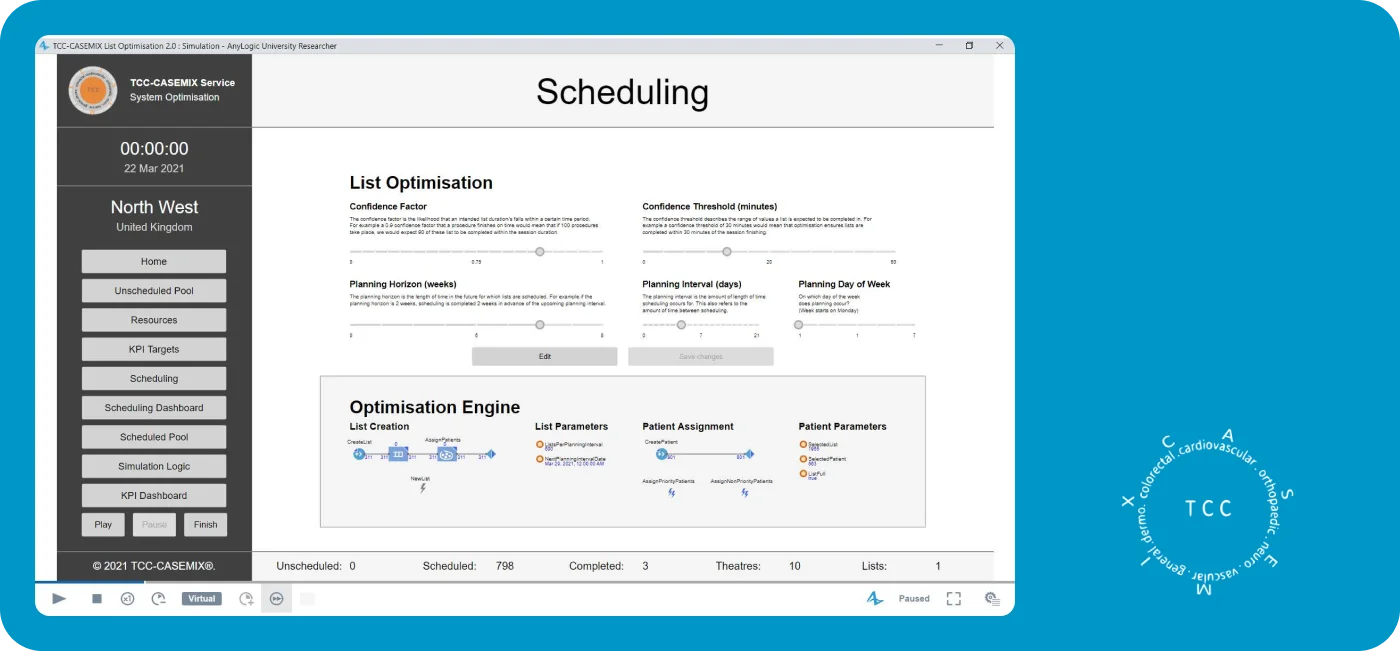
Combining machine learning and simulation for surgery planning. TCC-CASEMIX used machine learning to group patients into surgical risk profiles, then fed them into a multimethod AnyLogic model linked to its live database. In a four-week summer absence scenario at an acute care trust, the baseline schedule completed 82 surgeries. The optimized configuration completed 204.
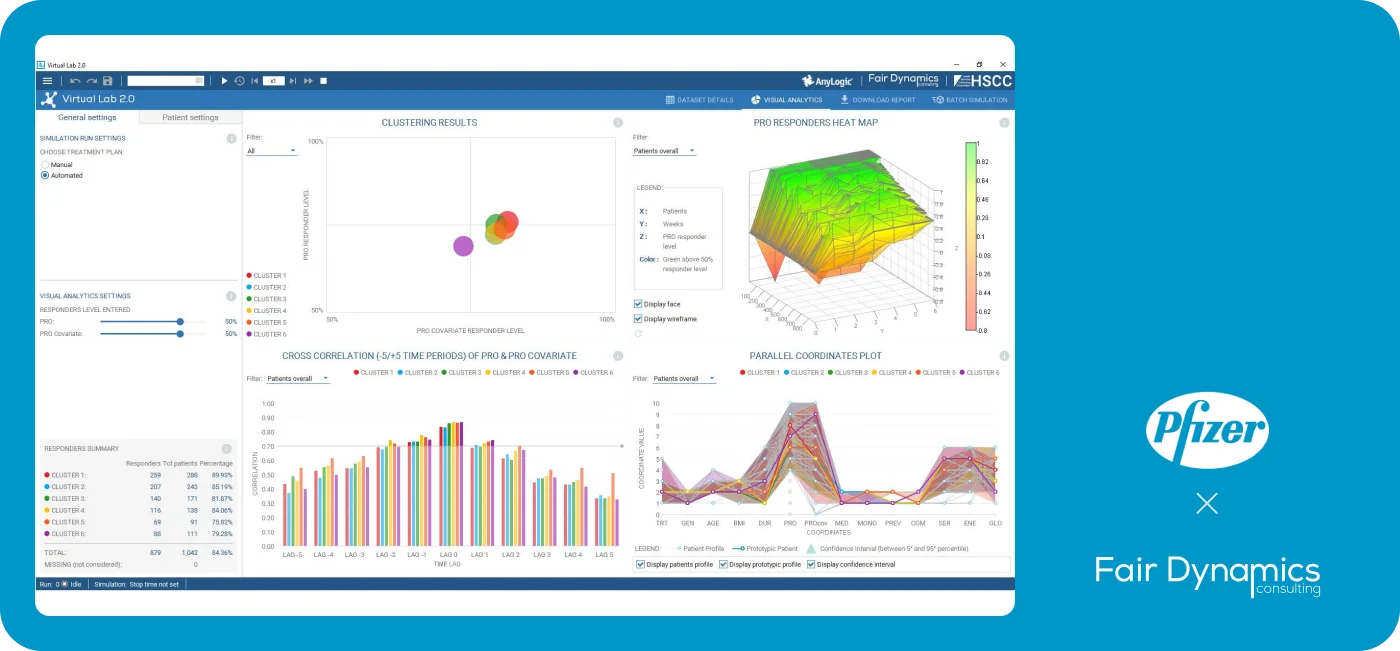
Personalizing treatment. For Pfizer, Fair Dynamics combined a clustering algorithm with agent-based simulation to forecast how individual patients with diabetic neuropathy would respond to a new drug and recommend a dosage.
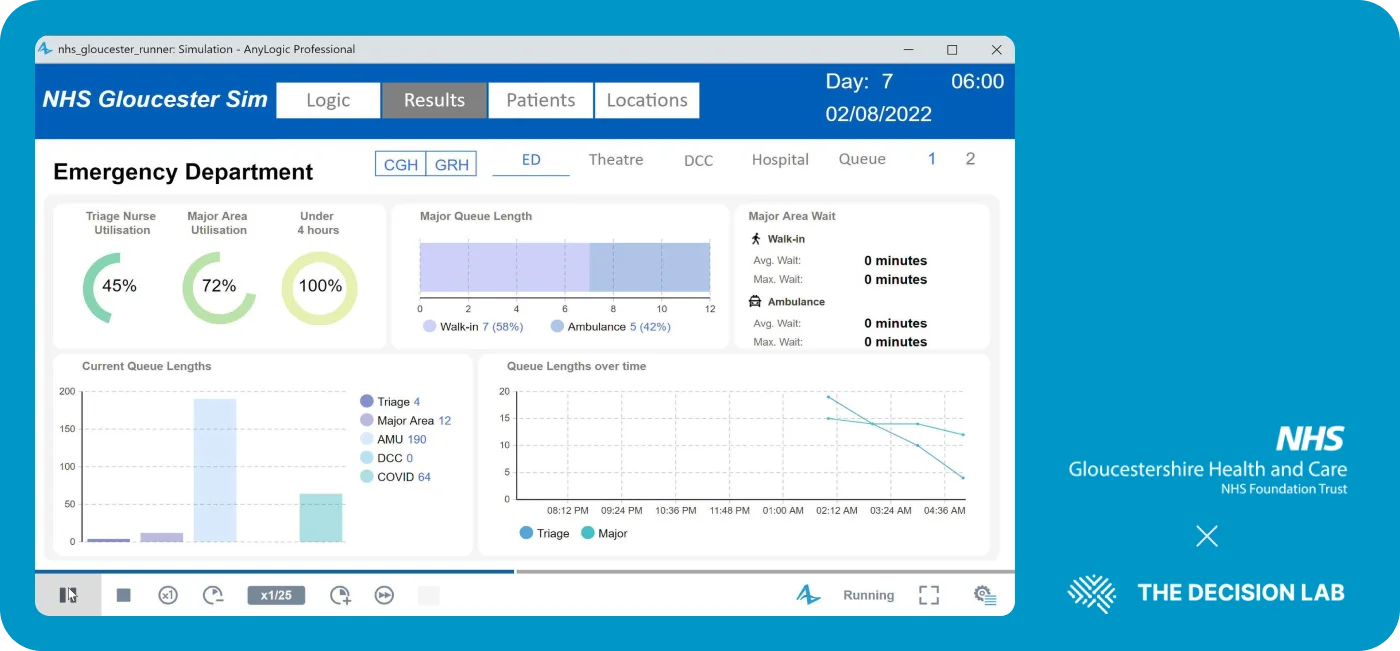
Building a hospital digital twin. For an NHS Foundation Trust, Decision Lab built a digital twin of two hospitals with 75 units, tracing elective and emergency patients from arrival to discharge.
Planning a hospital digital twin? Check out the An Introduction to Digital Twin Development white paper.
AnyLogic Desktop and AnyLogic Online: build where you work
A predictive model only helps if the people making decisions can use it. Most bed managers and clinical directors won’t install modeling software. That’s why we give our users two ways to work on the same model.
AnyLogic Desktop is the full modeling environment. It’s the right choice for detailed hospital digital twins, custom Java logic, and connecting machine learning models to your simulation.
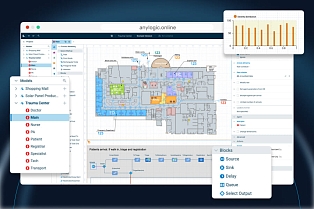
AnyLogic Online is a fully functional, browser-based modeling environment built on the same engine. You can build models, import schedules and demand data from Excel or databases, and run parameter variation, Monte Carlo, and optimization experiments in parallel in the cloud. Teams can edit the same project, manage versions, and build interactive dashboards.
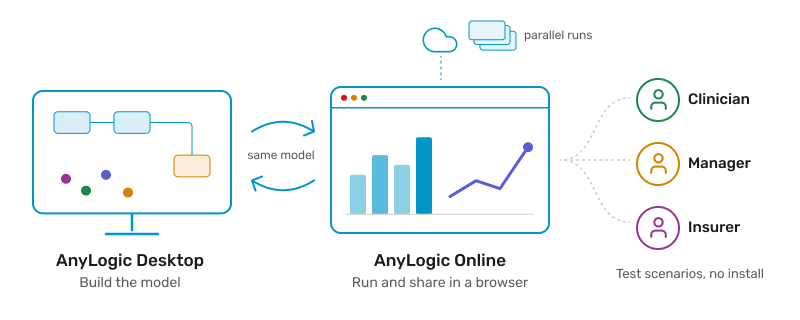
The two connect. A modeler can build the emergency department model on Desktop, then share it online so a hospital manager can change the number of beds or staff and compare results in a browser.
Choose your fighter, or don’t choose and use both.
Benefits for providers, insurers, and public health
Each part of the healthcare sector faces its own what-if question. Hospitals need to know whether their space and staff will cope. Insurers need to know how a policy change will ripple through their members. Public health teams need to know where capacity will run out across a region. Simulation answers all three the same way: build a virtual version of the system, then test decisions on it before making them for real.
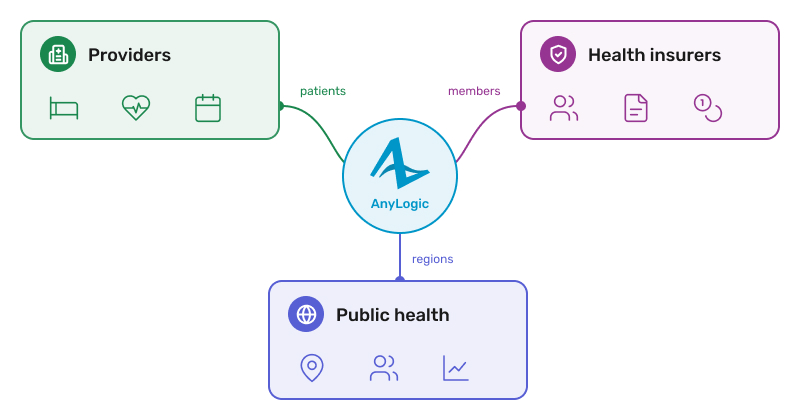
Hospitals and providers use simulation to size beds, staff, and operating rooms against forecast demand and to test new layouts before construction. Karolinska University Hospital used an AnyLogic model to compare care concepts for its new maternity ward under identical demand.
Health insurers are betting on prediction. In a 2026 Innovaccer survey of leaders at 63 health insurers, risk stratification and predictive analytics topped near-term AI priorities, cited by 60%. Yet 86% said they are not fully ready to operationalize AI at scale. Simulation can close that gap, for example by testing how a change in care management or provider networks would play out across members before rolling it out.
Public health agencies need to plan at the scale of entire regions. Lean Business Services built an AnyLogic agent-based model for Saudi Arabia covering 33 million people, 2,700 primary healthcare centers, and 21 clusters to forecast demand and test capacity scenarios.
How can healthcare providers implement predictive modeling effectively?
Start small. Pick one decision that matters, build predictive modeling around it, and grow the model into a digital twin over time.
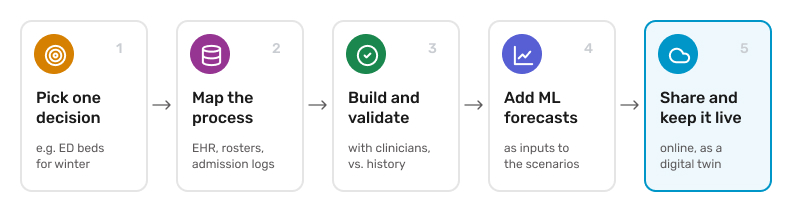
Validate the model against historical data and involve clinicians from day one. A model they helped build is a model they’ll trust.
FAQ
How is predictive analytics transforming patient care?
Predictive analytics in healthcare helps clinicians spot at-risk patients earlier, personalize treatment, and cut waiting times by matching capacity to demand. The catch is accuracy: one widely used sepsis model missed 67% of cases in external validation. Pairing prediction with simulation lets teams test how a new protocol or alert changes patient flow before it reaches the bedside.
What benefits does predictive analytics bring to health insurance companies?
Payers use it to forecast member risk and costs, target care management, detect fraud, and support risk adjustment. 63% of payers already use predictive analytics, and 61% of payer and provider executives expect their investment in it to pay off (SOA, 2019). Simulation adds the ability to test network and benefit changes across a whole member population.
What are some successful examples of predictive analytics in healthcare?
Common examples include early-warning scores for sepsis and deterioration, readmission and no-show prediction, and emergency department demand forecasting. Combined with simulation, results get more concrete. TCC-CASEMIX used machine learning and an AnyLogic model to raise completed surgeries from 82 to 204 in a four-week absence scenario. An AnyLogic emergency department model showed that 25% more beds cut overload and recovery time by 30%.
Use AnyLogic for predictive modeling in healthcare analytics
Forecasts tell you what’s coming. Simulation tells you what to do about it. With AnyLogic, you can bring predictive analytics in healthcare and simulation together in one model, then share it with the people who make decisions, whether they work on the desktop or in a browser.