Supply chains are complex, interconnected systems. A change in one part of the network can affect operations across multiple facilities, transportation routes, suppliers, and distribution channels. Demand fluctuations, seasonal patterns, transportation schedules, and unexpected disruptions make supply chain planning particularly challenging.
Traditional planning approaches often focus on individual processes or predefined assumptions. However, understanding how the entire supply chain behaves requires a more comprehensive perspective.
Simulation modeling with AnyLogic enables organizations to represent supply chains at different levels of detail, combine multiple modeling approaches, and explore how changes in one part of the system affect the whole network. This makes it possible to evaluate flexible strategies under a wide range of conditions.
Contents:
- Supply chains as interconnected systems
- Different levels of detail
- Combining modeling methods
- Accounting for real-world constraints
- Using geographic detail
- Analyzing performance
- From network models to real-world operations
- FAQs
- Taking your supply chain modeling further
Supply chains are interconnected systems
A supply chain is rarely a collection of independent operations. Manufacturing capacity affects inventory levels, warehouse performance influences delivery schedules, and transportation availability determines whether products reach customers on time.
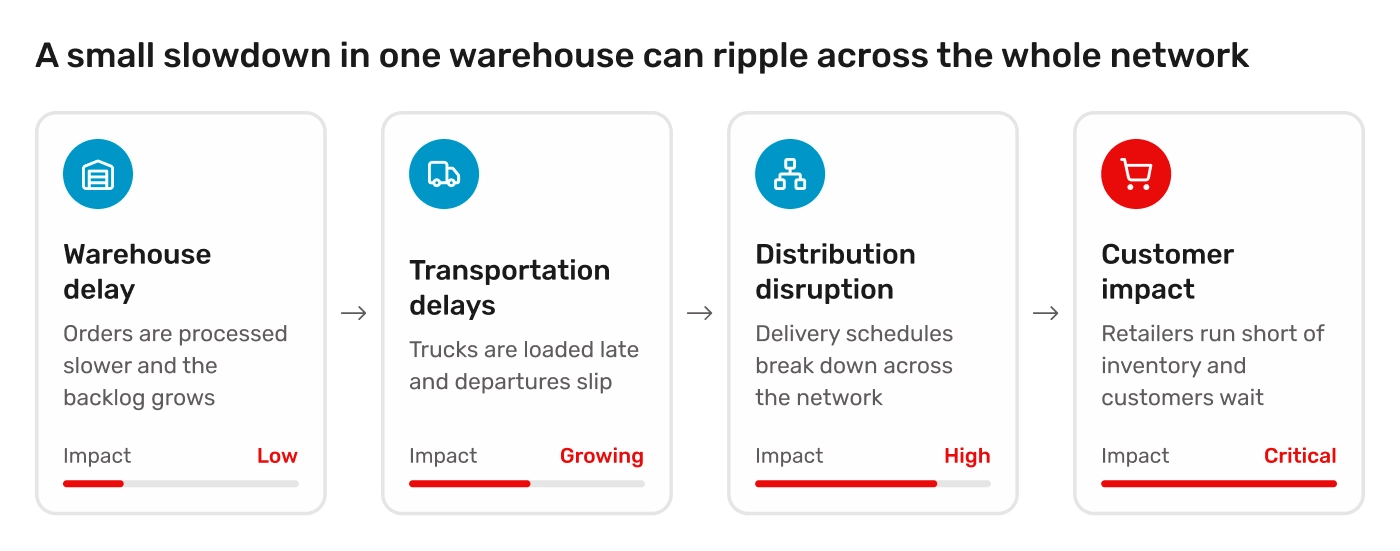
Consider a warehouse that starts processing orders more slowly than planned. This may increase order backlogs, delay truck loading, disrupt delivery schedules, and eventually cause inventory shortages at retailers.
This is the butterfly effect in supply chain operations: a relatively small change in one location can trigger consequences throughout the network.
Another example is the bullwhip effect, where small fluctuations in customer demand become increasingly amplified as they move upstream from retailers to wholesalers, manufacturers, and suppliers. This can lead to excess inventory, production inefficiencies, and higher operating costs.
Supply chain simulation helps uncover these relationships. Instead of evaluating individual facilities or transportation operations in isolation, companies can analyze how the entire system responds to changes and identify where vulnerabilities exist.
Modeling supply chains at different levels of detail
One of the key challenges in supply chain planning is finding the right level of detail.
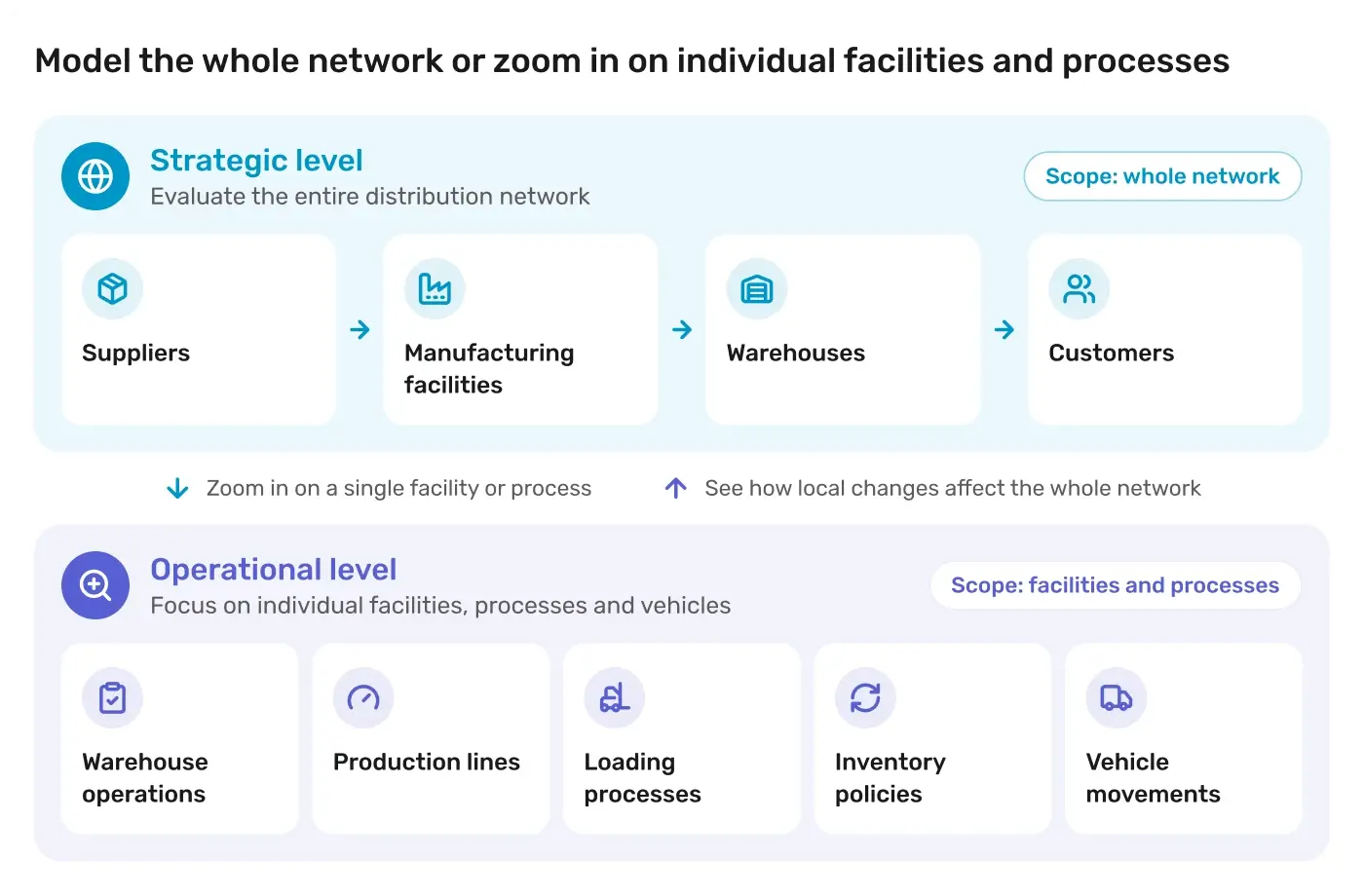
At the strategic level, companies evaluate entire supply networks, including suppliers, manufacturing facilities, warehouses, and customers. At the operational level, the focus shifts to individual warehouses, production lines, loading processes, inventory policies, or vehicle movements.
AnyLogic supports scalable supply chain modeling, allowing users to move between high-level network views and detailed simulations of individual facilities and processes.
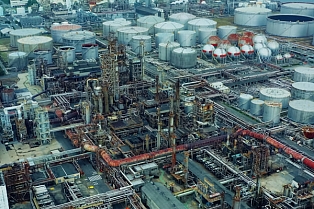
The Oil Supply Chain model demonstrates this approach. It represents the flow of crude oil from tankers and port storage facilities through pipelines and refineries to terminal storages and retailers. Users can explore the supply chain from a network-wide perspective or get into detailed operations such as tanker behavior at individual ports, making it possible to evaluate decisions at multiple levels.
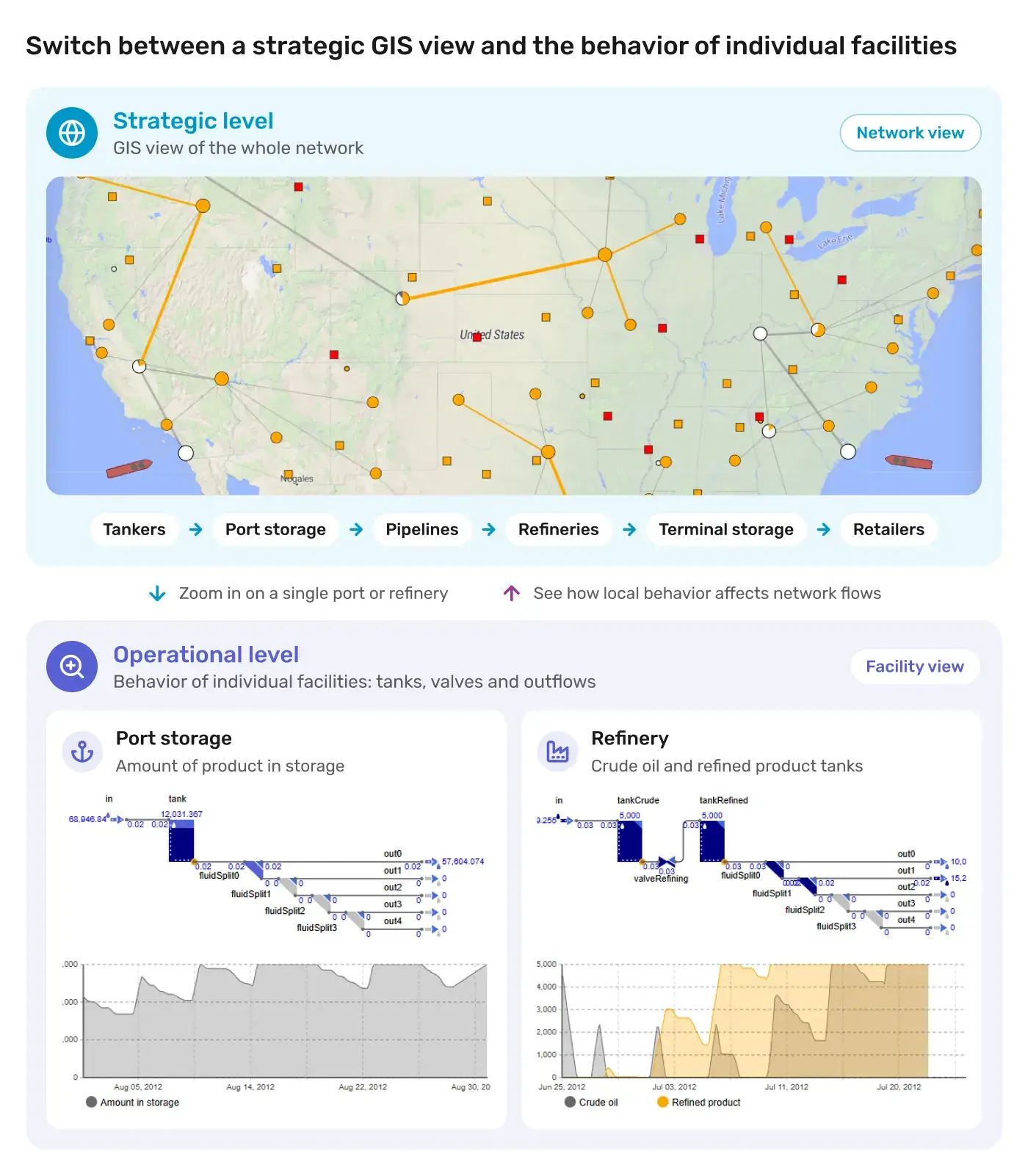
This ability to connect network-level and operational-level representations is valuable when analyzing complex supply chains.
Combining modeling methods to capture supply chain complexity
Different supply chain challenges require different modeling perspectives:
- Discrete-event modeling represents operational processes such as order processing, production, warehouse operations, and material handling.
- Agent-based modeling captures individual entities, such as suppliers, customers, vehicles, and facilities, with their own behavior.
- System dynamics analyzes aggregate processes and feedback relationships, such as inventory accumulation, demand fluctuations, and capacity constraints.
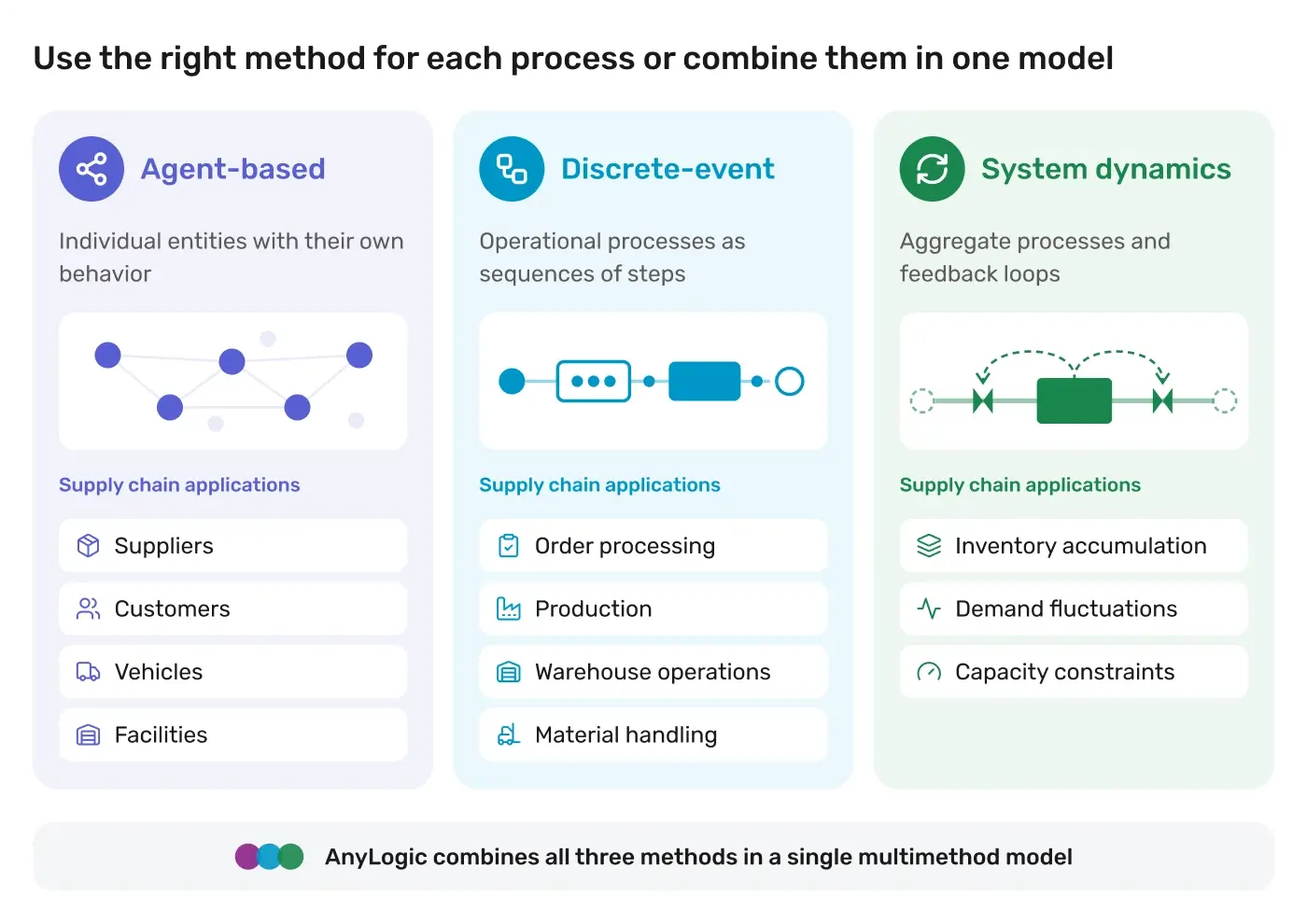
AnyLogic allows these approaches to be combined within a single model through multimethod modeling. Organizations can choose the appropriate method for each part of the system instead of simplifying the entire supply chain to fit one approach.
For example, the Manufacturing & Logistics model combines all three methods. Distributors, trucks, and manufacturing facilities are represented as agents; warehouse order processing, loading, and palletizing use discrete-event modeling; and production and hiring at manufacturing sites use system dynamics. Trucks also move along real roads in GIS space.
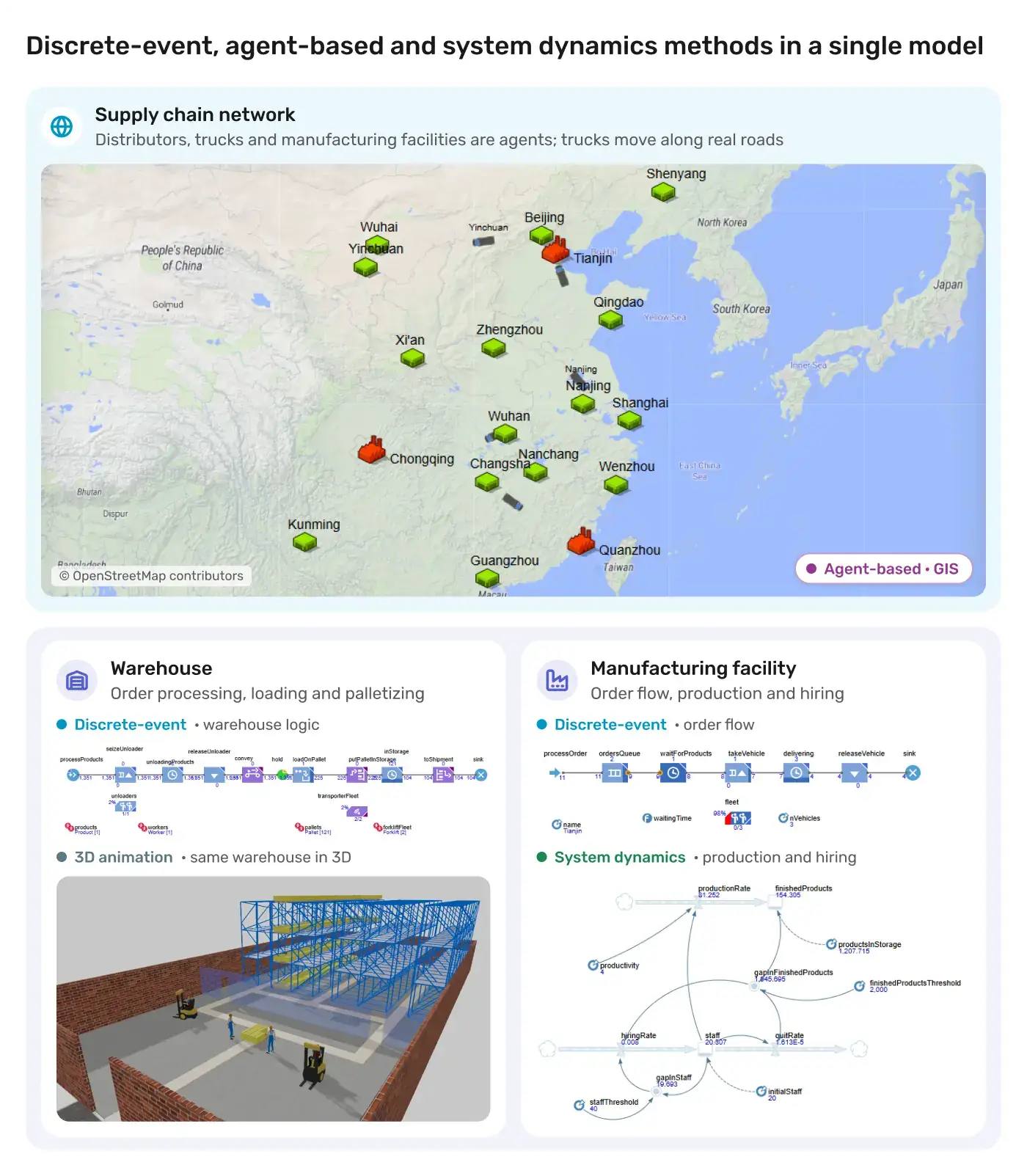
Users can explore individual warehouse operations, adjust parameters, and observe how local changes affect the wider supply chain.
Accounting for real-world constraints and changing conditions
Supply chain planning involves more than calculating transportation distances or estimating average delivery times. Real operations depend on factors that change over time.
For example, seasonal demand fluctuations can affect transportation capacity, workforce availability, and supplier performance. Weather conditions and unexpected disruptions add further complexity.
AnyLogic allows these factors to be represented through time-dependent parameters, resource constraints, and behavioral rules.
The Container Line model simulates ships delivering containers to seaports. In one scenario, a storm in the Pacific Ocean slows a vessel, increasing its transit time. Users can observe how this localized disruption affects vessel schedules and cargo deliveries across the network.
The Container Line model simulates ships delivering containers to seaports. In one scenario, a storm in the Pacific Ocean slows a vessel, increasing its transit time. Users can observe how this localized disruption affects vessel schedules and cargo deliveries across the network.
Simulation makes it possible to investigate disruptions without putting actual operations at risk. Organizations can compare alternative strategies, identify vulnerabilities, and understand the potential consequences of unexpected events.
Using geographic detail to improve supply chain models
Geography is an essential part of many supply chain decisions. Facility locations, road networks, transportation infrastructure, and regional conditions all influence operational performance.
AnyLogic provides advanced GIS capabilities, including online maps and routing. GIS shapefiles can enrich models with geographic and operational data such as infrastructure, routes, administrative boundaries, and custom attributes.
This enables companies to model transportation networks using actual road layouts and weather conditions, analyze routes between facilities, and evaluate how regional infrastructure affects logistics operations.
Analyzing performance with statistics and experiments
Building a supply chain model is only part of the planning process. Organizations also need ways to measure system performance, compare alternatives, and evaluate different strategies.
AnyLogic provides tools for collecting simulation statistics and visualizing key performance indicators, such as inventory levels, operating costs, resource utilization, and product availability.
For example, the Oil Supply Chain model includes dashboards that show how crude oil and refined product inventories change across different stages of the supply chain. Another chart tracks periods when retailers run out of fuel.
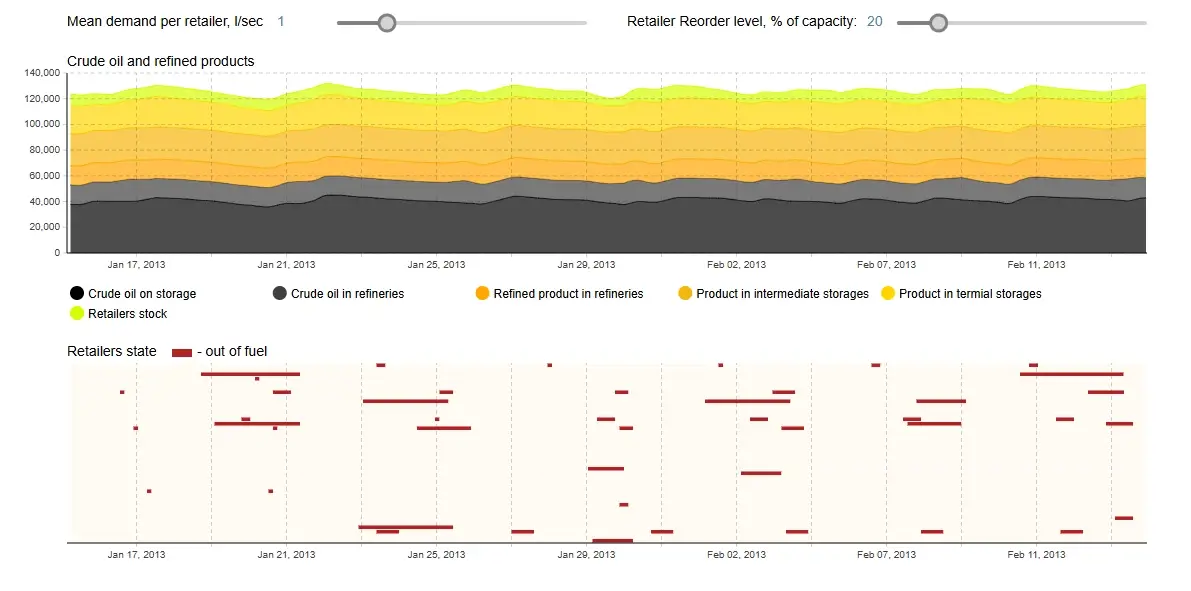
In AnyLogic Online, users can configure experiments to explore different parameter settings, run parameter variation and Monte Carlo experiments, or apply optimization. Customizable dashboards bring model inputs and outputs together, while charts help visualize and analyze results. Completed runs are stored for further analysis, and the Comparison view allows users to compare the inputs and outputs of multiple experiments side by side.
From network models to real-world operations
Effective supply chain planning is not only about finding one optimal configuration and assuming it will remain so under all circumstances. It is about understanding the relationships within the network, recognizing vulnerabilities, and evaluating decisions under changing conditions.
AnyLogic provides a flexible simulation environment for building models that reflect the complexity of real-world supply chains. Its key capabilities include:
- Scalability and multimethod modeling: Model an entire supply chain network or individual facilities and processes at different levels of detail. Combine discrete-event, agent-based, and system dynamics approaches.
- Specialized libraries: Use Material Handling for warehouse and manufacturing operations, Road Traffic and Rail for transportation, Fluid for liquids and bulk materials, and Process Modeling for logistics workflows.
- Operational flexibility: Incorporate schedules, resource constraints, seasonal patterns, and changing conditions.
- Advanced GIS capabilities: Use geographic data, online maps, routing, and shapefiles.
- Scenario analysis and optimization: Run experiments, analyze statistics, and compare alternatives.
- Data integration: Connect models to external systems and use live data through APIs.
- AI-assisted supply chain modeling: Use AI-powered capabilities to accelerate model development, simplify modeling tasks, and help build complex supply chain simulations more efficiently.
All interactive models featured in this article can be further explored and edited in AnyLogic Online. The platform enables users to build, run, and share simulation models directly in a browser.
FAQs
How can simulation improve supply chain planning?
Simulation helps organizations understand how their supply chains behave under different conditions. Companies can identify bottlenecks, evaluate disruptions, compare strategies, and test decisions before implementing them in real operations.
What simulation methods can be used for supply chain modeling?
Supply chain models can use discrete-event simulation for operational processes, agent-based modeling for individual entities, and system dynamics for aggregate processes and feedback loops. AnyLogic supports all three methods and allows users to combine them in a single model.
Can AnyLogic integrate real-world geographic and operational data into supply chain models?
Yes. AnyLogic supports GIS integration, including online maps, routing, and shapefiles. It also supports API-based integration with external systems, allowing models to use live or regularly updated operational data.
Taking your supply chain modeling further
If your primary goal is to optimize supply chains using ready-to-use analytical tools, including Network Optimization, Cost-to-Serve analysis, Greenfield Analysis (GFA), Inventory Optimization, and Last-mile Optimization consider anyLogistix.
anyLogistix is dedicated supply chain design, optimization, and simulation software. It provides purpose-built functionality for supply chain network design, cost analysis, inventory optimization, and risk analysis. You can explore its capabilities hands-on with anyLogistix Sandbox, a free browser-based environment for experimenting with supply chain scenarios.
AnyLogic provides a flexible environment for modeling complex supply chains. Combine different simulation methods, explore operations at various levels of detail, and build models tailored to your specific business challenges.
Ready to explore the possibilities? Try AnyLogic and start building your own supply chain models.