When people think about pharmaceutical innovation, they usually picture laboratories, clinical trials, and breakthrough therapies.
But every medicine depends on something far less visible: a supply chain capable of delivering the right product, in the right quantity, at the right place and time.
Unlike many consumer products, pharmaceuticals move through a tightly controlled ecosystem where delays, shortages, or quality issues can directly affect patients. A single disruption can have consequences far beyond lost revenue.
In this blog post, based on HCLTech’s presentation at the AnyLogic Conference 2025, we'll explore what makes pharmaceutical supply chains so complex, why traditional visibility tools often fall short, and how multimethod simulation and digital twins can help organizations move from monitoring operations to testing decisions and building resilience.
Contents:
- What a pharma supply chain looks like
- Why visibility alone isn't enough
- When multimethod simulation and digital twins become necessary
- The HCLTech example
- FAQs
- Download AnyLogic
What does a pharma supply chain look like?
At a high level, the pharmaceutical supply chain management can look relatively straightforward. Raw materials and ingredients are sourced from suppliers and transported to manufacturing facilities. Once production is complete, finished products move through distributors before reaching hospitals, pharmacies, and ultimately patients.
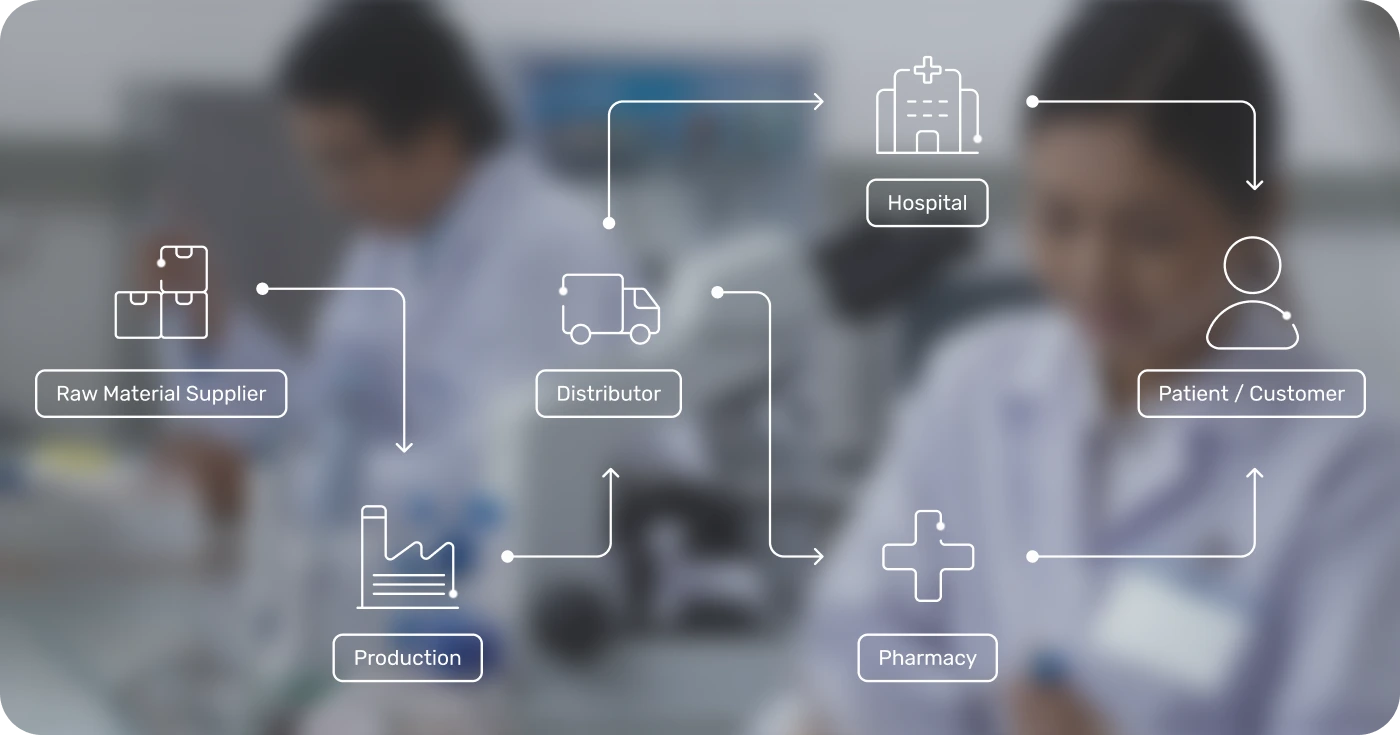
However, beneath this seemingly linear flow lies a highly interconnected network of organizations, facilities, transportation providers, warehouses, and regulatory processes. This complexity means that each stage brings its own operational challenges for pharmaceutical supply chain optimization:
- Suppliers may experience shortages or quality issues.
- Manufacturing facilities must manage production schedules, batch processing, and compliance requirements.
- Distributors balance inventory across multiple regions.
- Hospitals and pharmacies face fluctuating demand patterns.
And the stakes are high. Pharma supply chains operate under unique pressures. For example, drug shortages in the United States have reached record levels, with more than 300 active drug shortages reported in 2024. This is the highest number since tracking began in 2001. Many medicines depend on globally sourced ingredients, specialized manufacturing processes, strict quality controls, and carefully managed distribution networks.
Why isn’t visibility alone enough?
To provide the required pharma supply chain data, nowadays IoT devices can continuously stream information from manufacturers, logistics providers, and distributors and retailers. In theory, organizations now have more visibility in their operations than ever before.
However, visibility alone does not guarantee better pharmaceutical supply chain management. Why? Because most supply chain platforms are designed to answer questions about the present. Where is the shipment? How much inventory remains? Which facility is underperforming?
These are important questions, but they do not address the issues supply chain players increasingly care about:
- What happens if a supplier becomes unavailable next week?
- How will a sudden increase in demand affect product availability?
- Which distribution strategy minimizes risk and cost?
- Where will the next bottleneck emerge?
Answering those questions requires moving beyond reporting and into prediction. There is a need for the ability to safely test alternative decisions before implementing them in the real world. This is where traditional visibility tools fail to keep up.
When multimethod simulation and digital twins become necessary
On top of that, a pharmaceutical supply chain is more than a sequence of production and delivery steps. It is a network of independent participants, including manufacturing plants, distributors, retailers, and transportation fleets, that continuously interact and respond to changing conditions.
Capturing this complexity requires different simulation approaches working together. This is where AnyLogic’s multimethod modeling capabilities come in handy.
Using AnyLogic's agent-based modeling, supply chain entities can be represented as agents. Manufacturing centers, distributors, retailers, and vehicles each behave as independent actors with their own states and logic. For example, a delivery truck can have moving, loading, and unloading states. This approach enables emergent behavior analysis (e.g., fleet interactions and demand fluctuations).
At the same time, many supply chain activities follow structured operational processes. Orders are received, products are manufactured, inventory is stored, shipments are dispatched, and deliveries are completed. These workflows are well-suited for discrete-event modeling. It allows modelers to simulate activities such as order handling, queueing, loading, transportation, unloading, and inventory movements as a sequence of events. This approach also enables organizations to measure operational KPIs such as fleet utilization, throughput, waiting times, and delivery performance.
Individually, each approach provides only part of the picture. Together, they create a more realistic representation of supply chain behavior and a better way for pharmaceutical supply chain optimization.
Multimethod modeling is particularly valuable in pharmaceutical supply chains, where demand fluctuations, inventory constraints, production schedules, and transportation disruptions can influence the performance of the entire network. By bringing them together within a single digital twin, organizations can better understand system behavior, evaluate alternative strategies, and explore "what-if" scenarios before making real-world decisions.
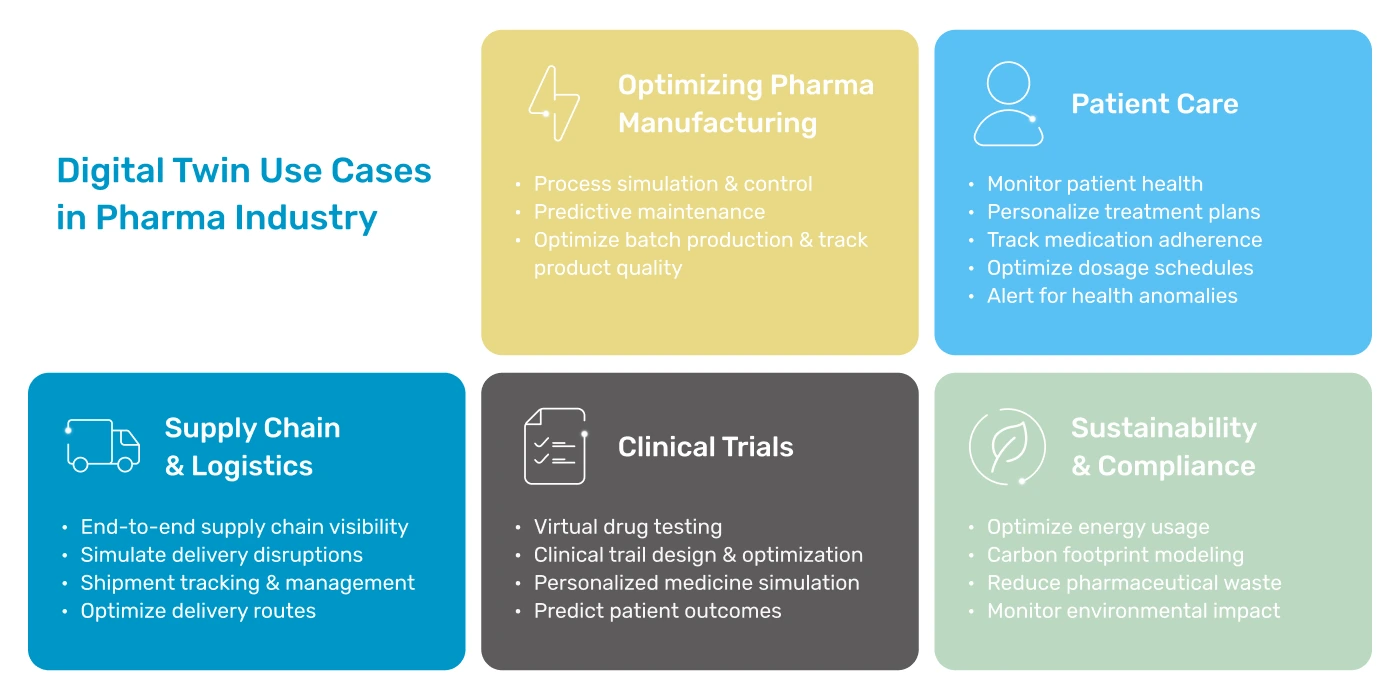
Check out our white paper about multimethod simulation for business applications to find out more about multimethod simulation modeling and how to benefit from it while building your pharma supply chain models.
The HCLTech success story
A recent pharmaceutical supply chain optimization project run by HCLTech illustrates this concept in practice.
The digital twin represents the complete flow of pharmaceutical products from suppliers through manufacturing facilities, distributors, hospitals, pharmacies, and ultimately patients. It combines manufacturing workflows with the operational interactions of supply chain participants, enabling planners to analyze both production performance and network behavior.
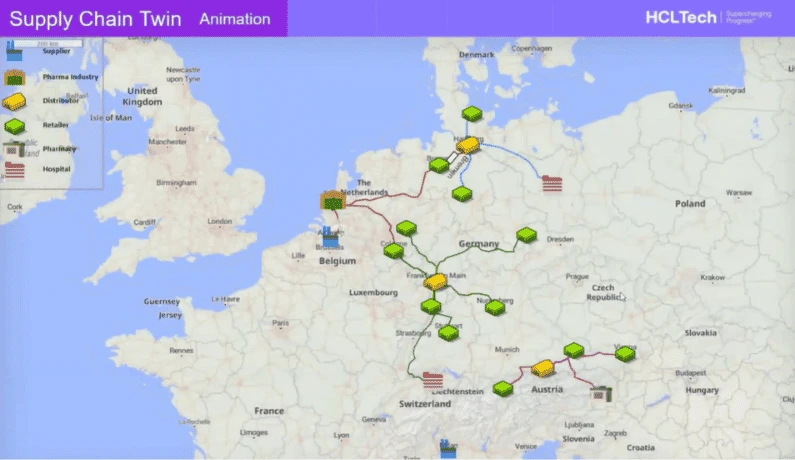

Rather than functioning solely as a monitoring tool, the digital twin, built using multimethod simulation capabilities of Anylogic, becomes a decision-support environment for pharmaceutical supply chain optimization.
The solution also provides operational dashboards for pharmaceutical supply chain optimization, tailored to different stakeholders across the supply chain. Manufacturing teams can monitor production metrics, inventory levels, storage capacity, pending orders, equipment performance, and Overall Equipment Effectiveness (OEE). Distributor dashboards offer visibility into storage utilization, order status, and product flows, while retailers gain the ability to track incoming inventory and product availability.
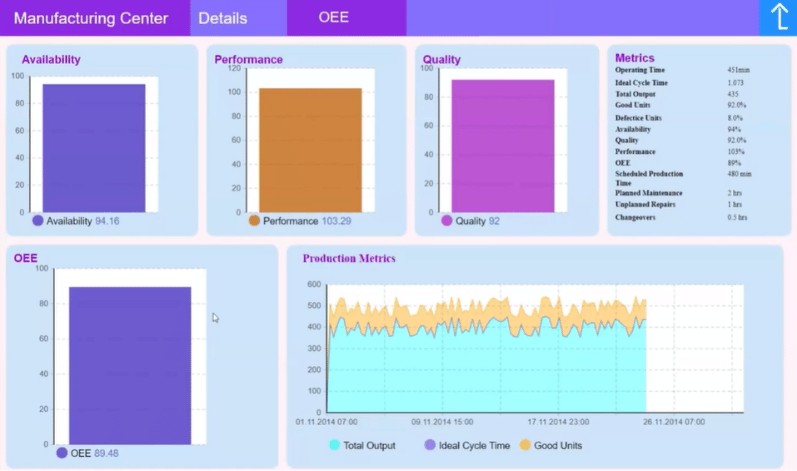
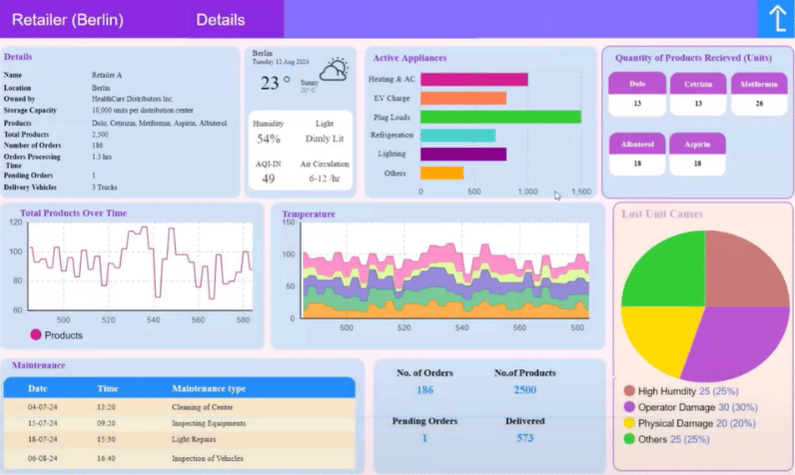
By integrating real-time operational data with the digital twin, users get a unified view of supply chain performance for end-to-end pharmaceutical supply chain optimization, from raw material sourcing and production to distribution and final delivery.
Importantly, these dashboards were not designed only for reporting. As a part of a digital twin and a risk-free experimentation environment, they allow users to move beyond visibility and explore how disruptions, demand fluctuations, capacity constraints, or logistics changes can affect future performance across the network.
The results of this project are promising. Adopting the innovative approach and moving beyond simple monitoring dashboards, the team:
- Improved supply chain sourcing resilience and visibility by up to 30%.
- Optimized the logistics cost for suppliers and manufacturers by ~20%.
- Enhanced decision-making, based on advanced analytics and simulation.
Check the video below with HCLTech’s presentation at the AnyLogic Conference 2025 to discover more about the project and its key results and takeaways.
Read also how AstraZeneca has achieved an antifragile supply chain with a strategic simulation platform built in AnyLogic.
FAQs
Which companies are leading in healthcare supply chain solutions?
The healthcare supply chain technology landscape includes enterprise software providers, logistics specialists, consulting firms, and simulation vendors. Organizations often combine solutions from multiple providers depending on their pharmaceutical supply chain management needs.
More often, pharmaceutical companies are adopting digital twin and simulation technologies to optimize their supply chains. Solutions built with AnyLogic enable organizations to model end-to-end networks, evaluate disruption scenarios, optimize inventory and distribution strategies, and test operational decisions before implementing them in the real world.
What technologies are transforming pharmaceutical logistics and fulfillment?
Pharmaceutical companies increasingly rely on digital twins and multimethod simulation to move beyond monitoring operations and toward testing decisions before implementing them in the real world. For example, using AnyLogic, organizations can create digital twins of their supply chains that combine agent-based modeling and discrete-event simulation to represent operational processes and interactions among manufacturers, distributors, retailers, and transportation fleets.
Together, technologies such as IoT, digital twins, and AnyLogic simulation models help companies improve pharmaceutical supply chain management, optimize logistics operations, and build more resilient networks.
Can you recommend best practices for international pharma packaging and distribution?
Visibility alone is often not enough to support effective pharmaceutical supply chain management. Organizations use digital twins and multimethod simulation to evaluate alternative decisions and understand how disruptions may affect the broader supply chain. With AnyLogic, companies can build supply chain digital twins. This enables teams to optimize distribution networks, improve resilience, and optimize pharmaceutical networks across regions.
The future of pharmaceutical supply chains is here
The pharmaceutical industry does not need more dashboards. It already has them.
What it really needs is the ability to experiment safely, evaluate alternatives quickly, and understand the consequences of decisions before they affect operations. The businesses that gain this capability will not simply have better visibility. They will have better foresight. And that will become the most valuable supply chain capability of all.
Ready to explore what's possible today? Download AnyLogic and start building your own supply chain digital twin now.