Smart manufacturing is moving fast, and the meaning of “smart” is changing. For a while, it sounded like a checklist: sensors, dashboards, manufacturing execution system integrations, maybe a bit of AI on top. Useful, but here’s the catch: having smart factory devices doesn’t automatically mean you’ve achieved smarter manufacturing. You still make decisions the old way, just with nicer screens.
A factory is a complex system. It has feedback loops and hidden constraints, where one change can shift bottlenecks, inventory, and staffing needs across the whole line. That’s why more data doesn’t always lead to better decisions. It can just create more metrics to track without showing what to do next.
In this post, we’ll cover the key trends shaping the future of smart manufacturing. Then we’ll dive deep into one trend that helps teams manage complexity in a practical way: digital twin technology in manufacturing.
Contents:
- The “smart” in smart manufacturing is changing
- 7 trends shaping the future of smart manufacturing
- Digital twin technology in manufacturing: from dashboards to decision engines
- Why the future of smart manufacturing is simulation-first
- Why AnyLogic fits modern manufacturing realities
- How smarter manufacturing teams build digital twins with AnyLogic
- FAQ
- Final thoughts
The “smart” in smart manufacturing is changing
Well, let’s start with what “smart” really means today.
Many factories are already “digital.” They collect data, track KPIs, and monitor equipment in real time. But when it’s time to change something, they rely on gut feelings and static planning.
The problem is simple: manufacturing performance is system performance. One local change can move the bottleneck, increase WIP (Work in Progress), or break the schedule. What looks like a win in one area can hurt throughput somewhere else.
That’s why smarter manufacturing is shifting toward decision testing. Leaders want to know, “If we do this, what happens to end-to-end flow, service, and cost?” before they touch the real line.
7 trends shaping the future of smart manufacturing
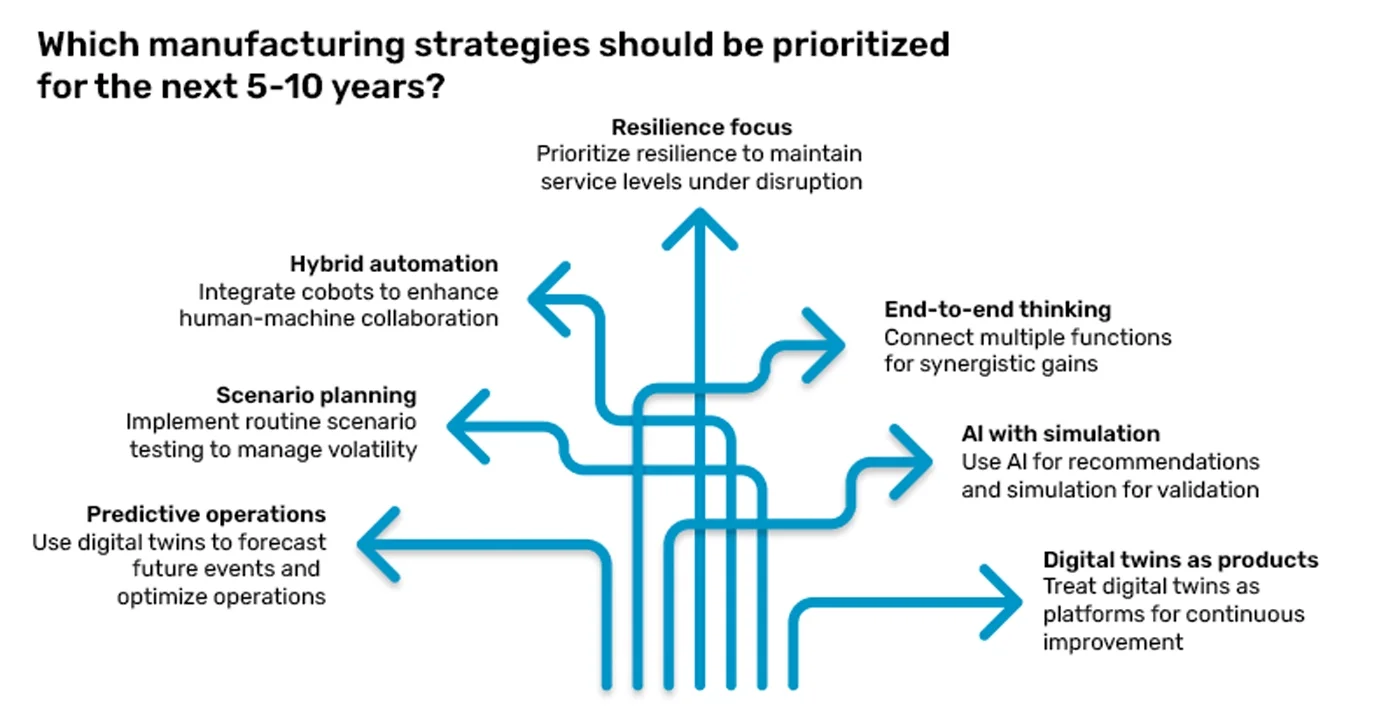
The strongest manufacturing strategies over the next 5–10 years will be built around a few trends that keep repeating across industries. These aren’t isolated “tech trends” but rather shifts in how factories compete.
1. From visibility to predictive operations
Dashboards tell you what happened. The future is systems that tell you what is likely to happen next—where your constraint will move, which orders are at risk, and what the cost of intervention will be. This is where simulation-backed digital twin technology in manufacturing stands out: it doesn’t just visualize the factory; it projects its behavior under different conditions.
2. “Scenario planning” becomes a daily habit
Volatility is no longer occasional. Demand spikes, supplier delays, energy price shifts, and labor constraints are becoming standard operating conditions. The future of smart manufacturing includes teams who treat scenario testing like a routine decision step: before changing schedules, before buying equipment, before promising lead times.
3. End-to-end thinking: production + intralogistics + supply network
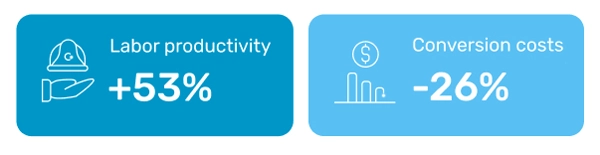
This is also why end-to-end programs outperform siloed improvements: when digital initiatives connect multiple functions, the gains stack. The World Economic Forum’s Global Lighthouse Network reports average results of +53% labor productivity and −26% conversion costs attributed to digital solutions such as AI, machine learning, and advanced analytics. Those numbers are hard evidence that cross-functional transformation is where “smarter manufacturing” becomes financially visible.
4. Smarter manufacturing focuses on resilience, not only efficiency
Pure efficiency can be fragile. The future favors operations that keep service levels even under disruption. Digital twin technology in manufacturing increasingly becomes a “resilience engine” for stress-testing policies and capacity buffers, measuring trade-offs, and preventing failures before they happen.
5. Hybrid automation becomes the norm
Hybrid automation is becoming the default because smarter manufacturers are scaling automation without eliminating the human layer. In fact, the Financial Times notes that cobots (collaborative robots) made up about 11% of all industrial robot installations by 2023, and they’re specifically designed to work safely alongside people, not behind cages. That’s a measurable indicator that human–machine collaboration isn’t a niche but a mainstream direction.
6. AI grows, but trust comes from simulation
AI can recommend actions, but leaders must still ask, “What happens if we do it?” Simulation becomes the validation layer that makes AI-driven recommendations explainable and testable. In practice, AI and simulation pair well: AI suggests, and simulation verifies.
Watch the AnyLogic webinar with Andrei Borshchev and Luigi Manca to learn more about what executives need to know about AI and simulation.
7. Digital twins move from “project” to “product”
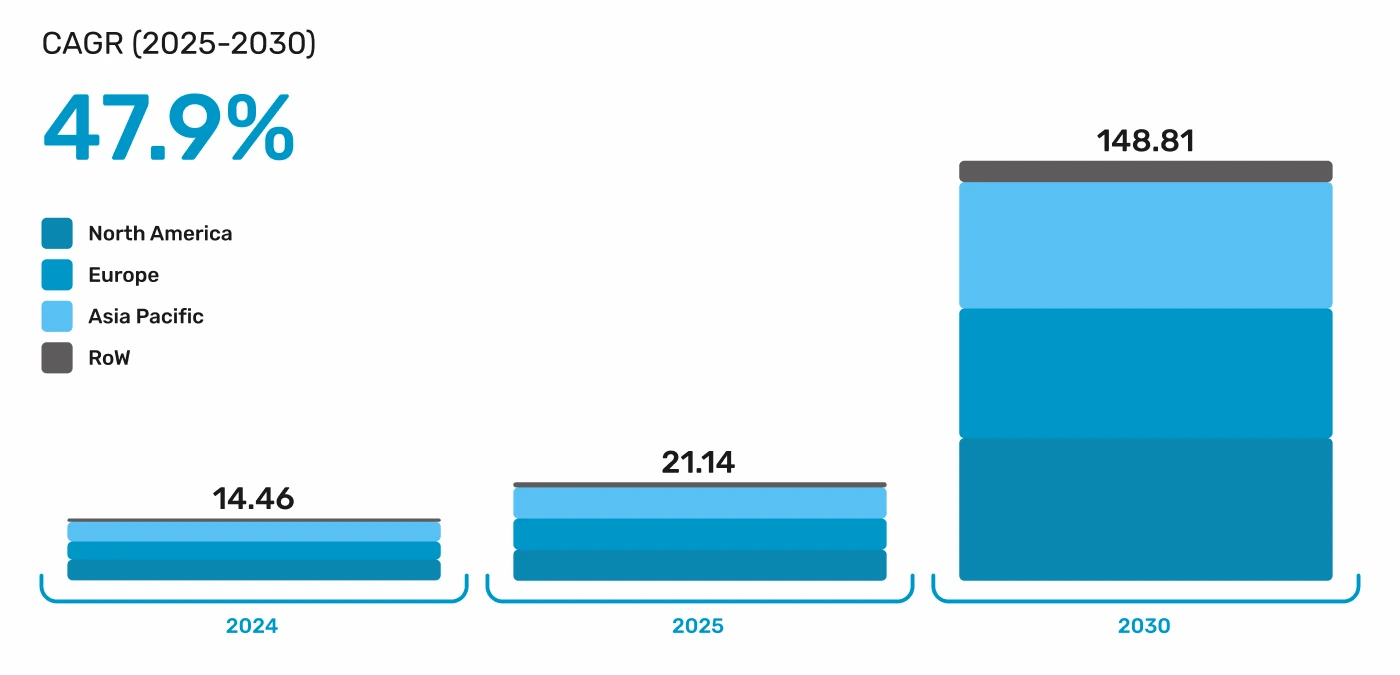
Digital twins are moving from an “interesting pilot” to an operational capability that gets funded, maintained, and reused because the market momentum is strong. The global digital twin market is expected to grow from $21.14 billion in 2025 to $149.81 billion in 2030. It is a clear sign that many companies now treat digital twins as long-term platforms, not one-off projects.
Each of these trends deserves its own in-depth exploration, as there’s far more to explore than a single paragraph can cover. However, in this post, we’ll focus specifically on digital twin technology in manufacturing and why it’s becoming a cornerstone of the future of smart manufacturing.
Digital twin technology in manufacturing: from dashboards to decision engines
A digital twin can mean many things. Many companies start with a “data twin,” a near real-time representation of assets and metrics. Helpful for visibility but limited for predictive questions.
What manufacturing teams increasingly need is a twin that can do three things:
- Represent how the system behaves over time (not a static snapshot).
- Explain why performance changes (cause-and-effect, not correlation only).
- Predict the impact of decisions (before you commit budget or disrupt production).
A simulation-based digital twin doesn’t just show you that OEE (Overall Equipment Effectiveness) dropped yesterday. It lets you test what will happen if you change the product mix next month, revise shift patterns, alter the changeover strategy, or respond differently to downtime.
That’s the operational meaning of the future of smart manufacturing: the factory becomes something you can simulate before you change it.
Why the future of smart manufacturing is simulation-first
Let’s be blunt: manufacturing decisions are expensive to test in real life.
A pilot line can take months. Retooling disrupts production. Hiring labor without clarity inflates cost. Buying equipment without knowing the system-level impact can lock in the wrong capacity for years.
Simulation changes the economics of decision-making. Instead of debating opinions, teams run scenarios and quantify trade-offs. You stop guessing whether a change “should” help and start measuring whether it does help—across throughput, lead time, service levels, WIP, overtime, and risk.
Business outcomes leaders care about
Most executives don’t buy “digital twin technology in manufacturing.” They buy outcomes.
| Business goal | Typical operational challenge | What digital twin technology in manufacturing helps you with | KPIs you can quantify |
|---|---|---|---|
| Increase throughput without overbuilding capacity | Bottlenecks shift by season or schedule | Identify real constraints and test targeted interventions | Throughput, utilization, queue times |
| Reduce WIP and inventory without service loss | Buffers hide problems; variability drives “safety stock creep” | Design buffer policies intentionally and test under uncertainty | WIP, inventory, service level |
| Improve on-time delivery in volatile conditions | Schedules break under disruptions | Stress-test schedules and policies against realistic disruptions | Lateness risk, lead time distribution |
| Speed up improvement cycles | Local optimizations create new downstream congestion | Validate end-to-end impact before implementation | Lead time, throughput, cost trade-offs |
| Align stakeholders across functions | Competing narratives and “my metric vs. yours” | Create a shared model to test options and agree on decisions | Shared scenario outputs, risk exposure, ROI |
If you’re exploring the future of smart manufacturing seriously, the fastest way to move from theory to impact is to build a small working model and start testing scenarios.
Download AnyLogic and create your first simulation model before scaling it into a digital twin as your data and maturity grow.
Why AnyLogic fits modern manufacturing realities
Manufacturing operations combine discrete events (jobs, setups, breakdowns), continuous processes (flows, levels), and people and policies (operators, dispatch rules, priorities). AnyLogic supports three simulation modeling approaches: discrete-event, agent-based, and system dynamics, and most importantly, their combinations.
In practice this means you can model:
- Production line logic, buffers, resources, and schedules with discrete-event simulation.
- Operator decisions, forklifts, decentralized behavior, and policy-driven variability with agent-based modeling.
- Higher-level flows like inventory dynamics and capacity feedback loops with system dynamics.
That flexibility matters because the “smart factory” reality is hybrid. The model has to be hybrid too.
How smarter manufacturing teams build digital twins with AnyLogic
A common reason digital twin initiatives stall is trying to build “the perfect twin” upfront—fully connected, fully detailed, and enterprise-wide. That path often turns a digital twin into a long IT program, while operations leaders are still waiting for answers to urgent questions about throughput, staffing, service levels, and cost.
Smarter manufacturing teams take a staged approach. They start with one decision that has clear business stakes (capacity expansion, schedule redesign, layout changes, workforce planning). Then they build a simulation backbone that captures the real constraints, validate it with stakeholders using outputs they trust, and only then connect data and scale the twin.

Recent AnyLogic manufacturing case studies show this pattern in action. Gousto, for example, used factory flow simulation as a reusable decision tool, validating model accuracy against real performance and then applying it to ongoing optimization questions as the business scaled.

Mayco International, an automotive supplier, worked with Bravo Delta Simulation to test production schedules and resource requirements before implementing changes. They turned the model into a practical planning asset rather than a one-off analysis tool.

Cargill used the operational model to support workforce capacity planning decisions. It helped them improve production efficiency and enabled managers to adjust staffing in real time as conditions changed.
The common thread is simple: digital twins get used when they deliver value early, earn trust through validation, and expand in increments. In other words, you’re not buying technology so much as building a capability for better decisions.
If you’re building a business case or aligning stakeholders, get our digital twin introduction white paper to clearly understand what a digital twin is (and isn’t) and how simulation delivers measurable ROI in smarter manufacturing.
Cloud as a force multiplier for digital twins
If your digital twin can only be run by one specialist locally, it stays niche. If stakeholders can run scenarios, review results, and collaborate, digital twin technology in manufacturing becomes part of how decisions are made.
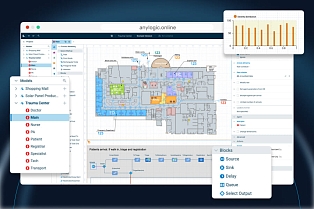
With AnyLogic Cloud, you can publish models so more people can use them. Teams can run experiments to test “what-if” scenarios and review completed runs later to compare results and see what changed.
It also supports teamwork. You can share a link, keep models in one library, and control who can view or run them. This helps operations, engineering, and leaders work with the same data instead of sending reports back and forth.
FAQ: Future of smart manufacturing and digital twins
What does smart manufacturing mean?
Smart manufacturing means using connected machines, data, and automation to run production better. The goal is faster decisions, fewer delays, and higher quality with lower cost. This is the future of smart manufacturing.
What is the future of advanced manufacturing?
The future of advanced manufacturing is more automation, more flexible production, and more use of AI and simulation. Companies will rely on digital twin technology in manufacturing to test decisions before making expensive changes.
What is digital twin technology in manufacturing?
Digital twin technology in manufacturing is a virtual copy of a production system that behaves like the real one. It lets teams run “what-if” tests to predict performance, find bottlenecks, and reduce risk.
How are digital twins transforming manufacturing?
Digital twins help manufacturers improve throughput, reduce lead times, and increase on-time delivery by testing changes safely in a virtual environment. This makes the future of smart manufacturing more predictable and less based on guesswork.
How to create a digital twin in manufacturing?
Start with one business problem (like capacity, scheduling, or maintenance) and build a simulation model of the process in AnyLogic. Then validate it with real data, add more detail over time, and use it regularly for scenarios. This is a practical path to digital twin technology in manufacturing.
What is the difference between smart factory and smart manufacturing?
A smart factory is one site with connected equipment and systems. Smart manufacturing is the bigger approach and includes the factory plus planning, supply chain, people, and decision-making across the business, supporting smarter manufacturing overall.
Turn smarter manufacturing into a competitive advantage with AnyLogic
Smart manufacturing is evolving from visibility to predictability and from predictability to confident action.
If you want smarter manufacturing that holds up under real-world complexity, simulation-based digital twin technology in manufacturing is one of the highest-leverage capabilities you can build.
Download AnyLogic software and start modeling your production system.