Hamid Tikani is a technical manager at AlsanX and a specialist in optimization and simulation. Holding a Ph.D. in Industrial Engineering, Hamid focuses on Industry 4.0 innovations, leveraging simulation, machine learning, and digital twin technologies to design smarter, more efficient, and sustainable logistics and infrastructure systems.
Global container port terminals face mounting pressure to balance operational efficiency with environmental responsibility. Rising fuel costs, stringent emissions regulations, and unpredictable vessel arrival patterns create complex scheduling challenges. Traditional static planning tools fail to capture dynamic interactions between ships, cranes, yard operations, and renewable energy systems.
At the same time, schedule reliability in global shipping still hovers at around 50–55%, meaning that nearly every second vessel arrives off schedule. This adds even more uncertainty to already complex port operations.
This is where smart port solutions come into play. In this blog post, let’s discover how combining simulation, real-time data, and advanced visualization can help move beyond static planning and unlock a new level of port optimization.
Contents:
- Why does port planning need an upgrade?
- What are smart port solutions in AnyLogic?
- Deeper insights with immersive visualization
- Benefits of VR integration
- Final thoughts
Why does port planning need an upgrade?
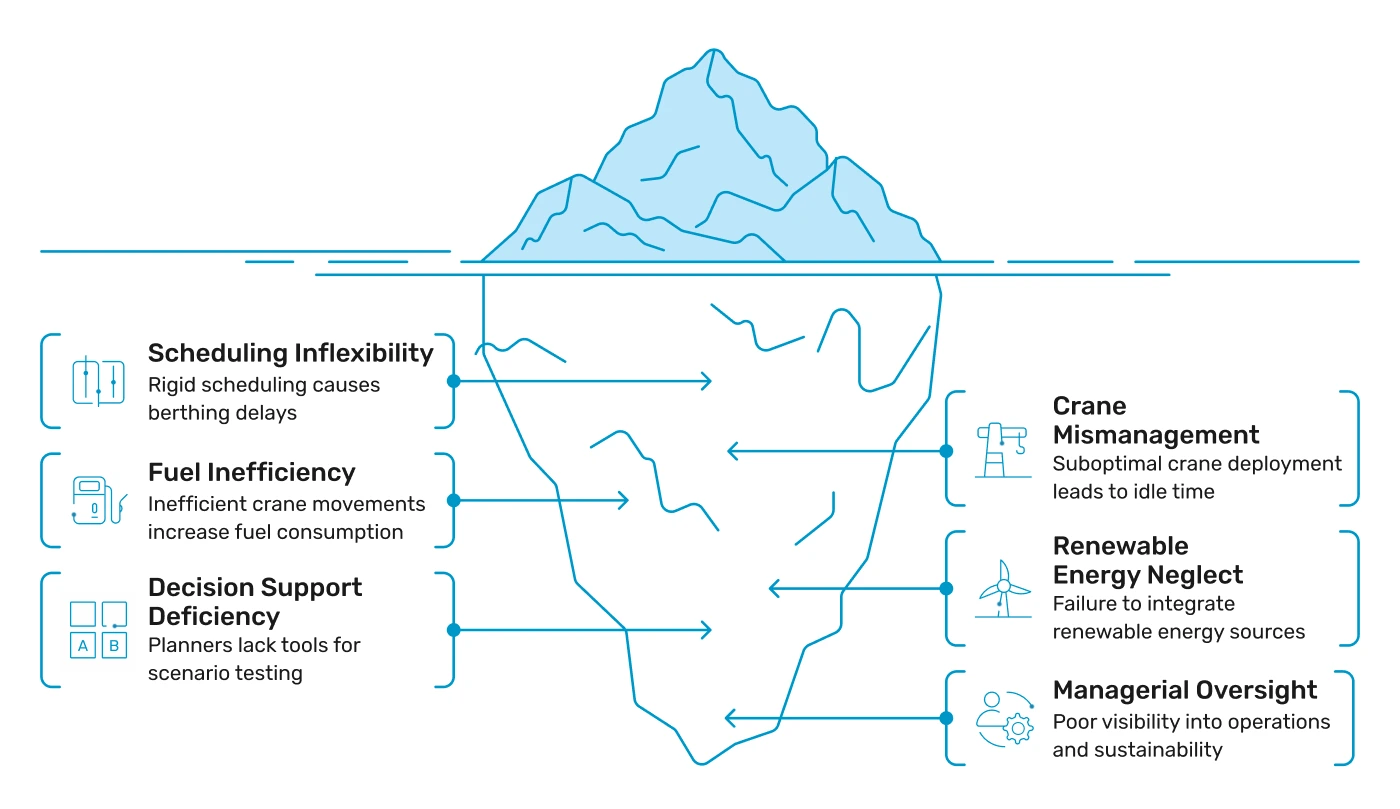
Many port terminals still rely on fixed schedules and manual coordination. While familiar, these methods often struggle with real-world complexity. Common issues ports face because of outdated optimization tools include:
- Prolonged ship berthing delays due to rigid scheduling and poor priority handling.
- High fuel consumption from inefficient yard crane movements and prolonged ship idling.
- Limited decision support with planners relying on spreadsheets with no scenario testing or sensitivity analysis.
- Suboptimal crane deployment, leading to idle time during peak demand and overload in others.
- No integration of renewable energy, missing opportunities to offset carbon footprint.
- Poor managerial visibility into real-time operations and long-term sustainability impact.
What are smart port solutions in AnyLogic?
To respond to the rising challenges, smart port solutions use digital technologies to create connected, responsive, and data-driven port environments. With tools like AnyLogic, port managers can build digital twins, virtual versions of their operations that reflect reality and predict the future. This enables teams to:
- Simulate vessel arrivals and departures.
- Test different scheduling strategies.
- Analyze cranes and yard performance.
- Identify inefficiencies before they occur.
- And much more.
In AnyLogic, you can leverage the Process Modeling library for discrete-event flows and the Material Handling library for crane and container operations. A Java-based optimization engine can run within the simulation. This way, it is possible to re-evaluate port schedules dynamically based on data, enabling closed-loop decision support.
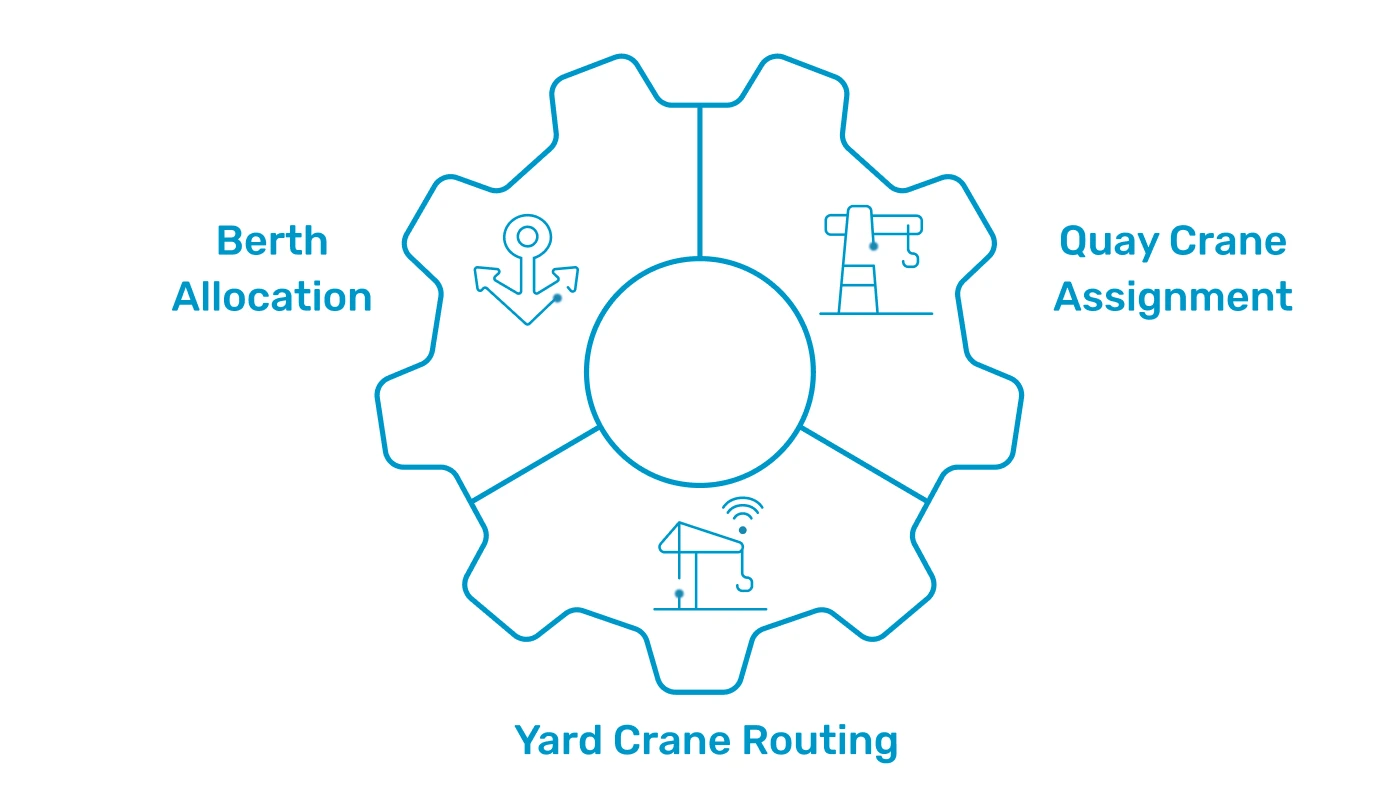
With multimethod modeling capabilities in AnyLogic, you can integrate both discrete-event and agent-based paradigms to replicate the dynamics of not only container handling but also vessel scheduling and crane operations. With such a smart port solution, operators can adjust ship and container priorities in real time to improve port optimization. At the same time, the system can track fuel consumption and simulate wind energy use to support sustainability goals.
Read also the blog post to discover how simulation has transformed infrastructure planning for the Transnet National Ports Authority.
Deeper insights with immersive visualization
To go even further and enhance managers’ and stakeholders’ engagement, AnyLogic models can be seamlessly integrated with NVIDIA Omniverse. It allows users to create a fully synchronized 3D and VR representation of entire port terminals.
Such a level of visual detail allows managers to immerse themselves in a dynamic digital twin of port operations. They can observe ship arrivals, crane movements, container handling, and yard workflows as if they were unfolding right in front of them. On top of that, they can interactively test different scheduling scenarios to improve efficiency and reduce bottlenecks.
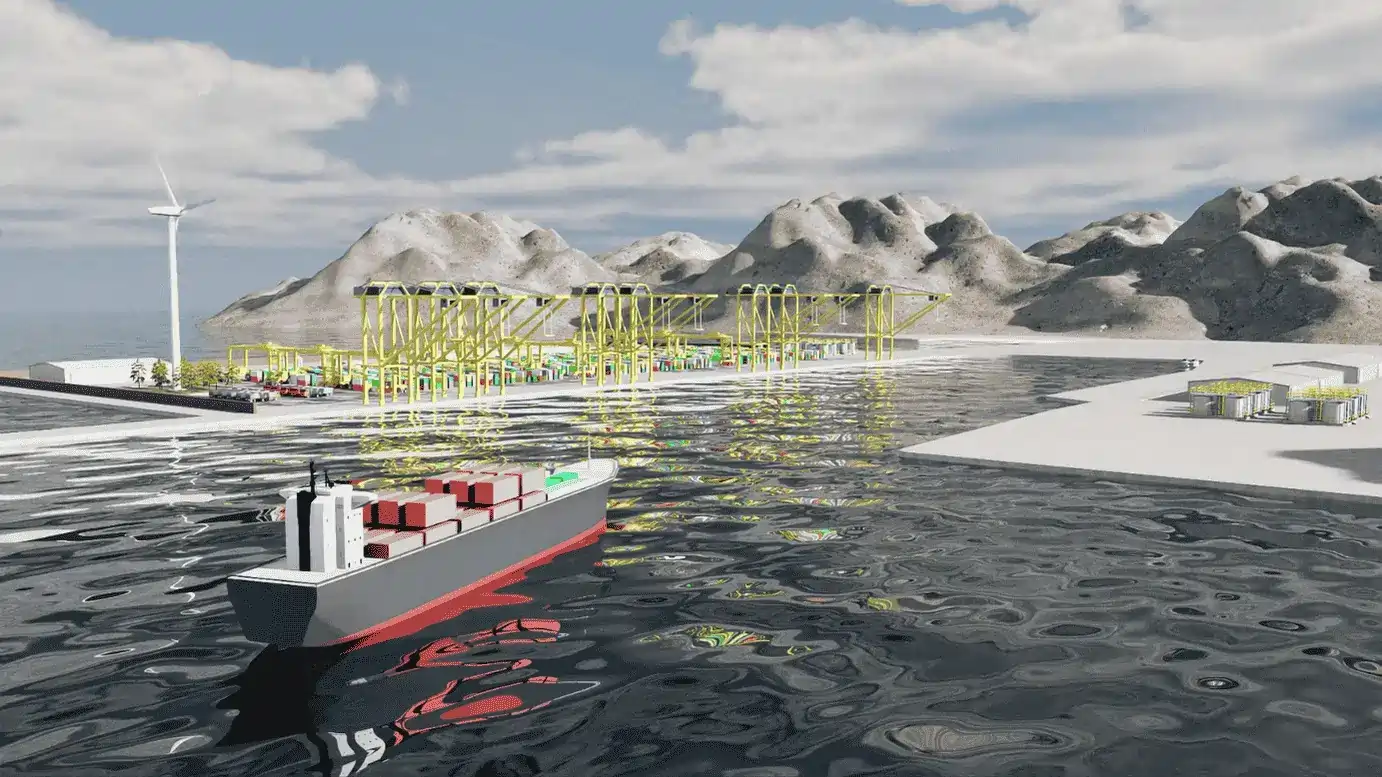
The integration leverages AnyLogic's Omniverse connector to stream live updates of your model, such as positional changes, visibility shifts, and attribute modifications, directly to Omniverse, ensuring precise synchronization with the simulation clock. Key features of this integration include:
- Photorealistic rendering that gives you physically accurate visuals, realistic lighting, and high-fidelity shaders for assets such as cranes, vessels, and wind turbines.
- Real-time synchronization with the simulation clock so you can watch scenarios evolve without lag.
- Virtual Reality (VR) walkthroughs that let you explore the terminal layout and operations from any angle during management reviews.
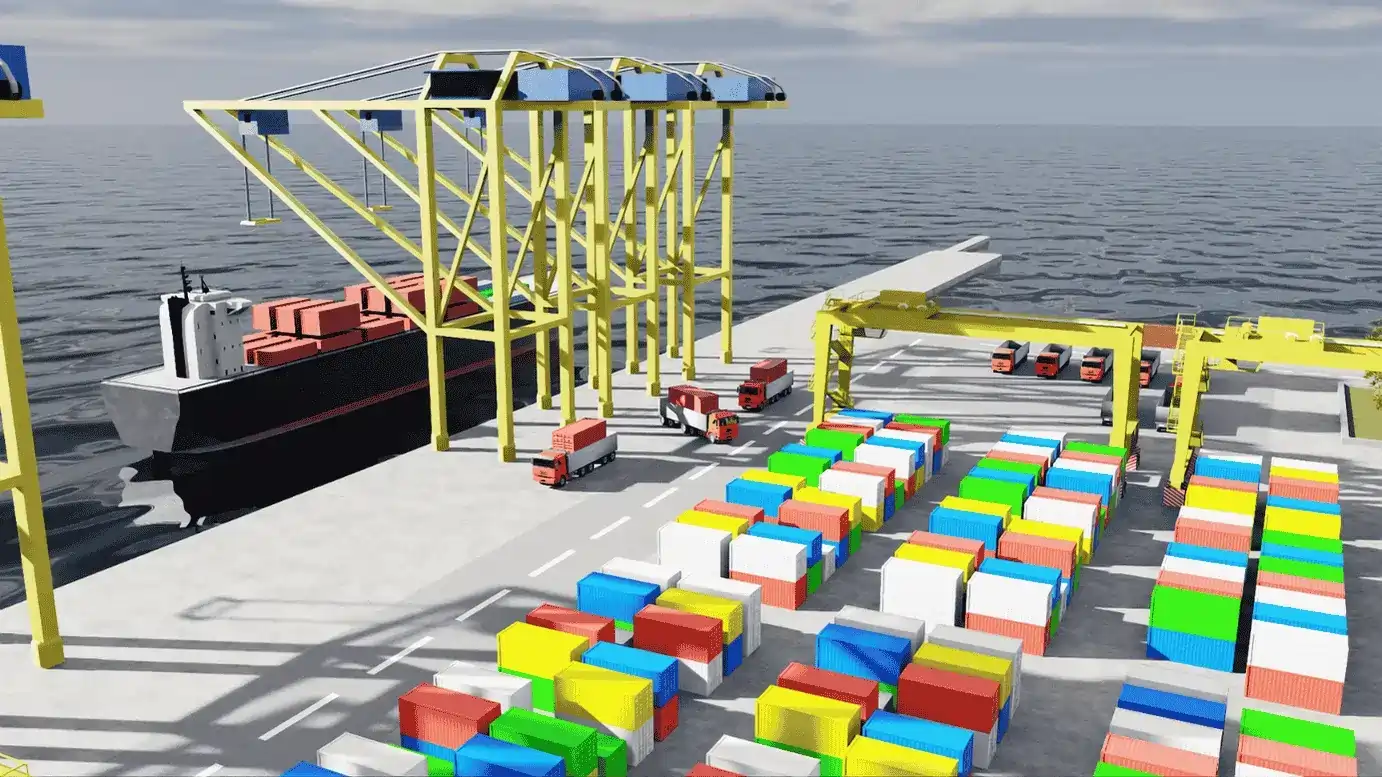
Find out all the details about AnyLogic’s integration with NVIDIA Omniverse and how companies from diverse industries benefit from it.
Benefits of VR integration
When it comes to training, VR is a natural next step once a high-fidelity model is in place. As part of smart port solutions, it provides a risk-free environment where operators can practice crane handling, vessel berthing, and emergency procedures in a virtual version of the port. This simulation-based approach speeds up skill development, improves learning retention, and helps meet safety standards. The result is a more capable and confident team in real-world operations.
For remote operations, this technology can be further developed to enable seamless multi-user access from anywhere in the world. This facilitates real-time monitoring and control of terminal activities without physical presence. Teams can synchronize views, annotate models, and collaboratively simulate adjustments, minimizing downtime and improving response times.
Check out as well the AlsanX case study on high-fidelity steel production digital twin with AI analytics. In this case, digital twin and VR technologies turned the meltshop into a safe, interactive training ground.
Final thoughts
Adopting smart port solutions can deliver immediate and quantifiable improvements in port operations. Many successful projects proved that ship waiting times can be significantly reduced through better scheduling and prioritization. Crane utilization can be optimized, ensuring more efficient allocation of resources during loading and unloading processes.
Most importantly, ports worldwide can gain the ability to continuously improve, rather than react to problems after they occur. Smart port solutions enable a new standard of port optimization, one that is dynamic, data-driven, and sustainable.
And if you’ve made it this far in our blog post, you’ll definitely want to see how these concepts come together in practice. Download AnyLogic for free and start building smart port solutions today!