
anyLogistix™ (ALX™), by AnyLogic Company is the supply chain software to design, optimize and analyze your company’s supply chain. It combines powerful analytical optimization approaches together with innovative simulation technologies offering you a comprehensive set of tools for end-to-end supply chain analytics. Join us in Chicago, July 24-26 for the anyLogistix 2.5 Workshop hosted by Anatoly Zherebtsov, Head of anyLogistix Development and Mike Wilutis, anyLogistix Sales Engineer. The Workshop will provide a deep understanding of how to implement anyLogistix to analyze and optimize your supply chain. See the agenda below, and register for FREE today!
Blog
anyLogistix Webinar, June 22nd

AnyLogic, the standard in simulation and modeling technology introduces anyLogistix™ (ALX™), the supply chain analytics software to design, optimize and analyze your company’s supply chain. It combines powerful analytical optimization approaches together with innovative simulation technologies offering you a comprehensive set of tools for end- to-end supply chain analytics.
Join us for the anyLogistix Supply Chain Software Webinar June 22, 10:30 am CDT!
Webinar Agenda:
AnyLogic 8.1 and AnyLogic Cloud: new features

AnyLogic 8.1 is released. The online service AnyLogic Cloud has also been updated and these features allow users to:
• ”Like” models , send personal messages to other users, and in the next few days you will be able to leave comments on models.
• Upload model source files along with your model and grant access to other developers. In the next few days, you will be able to make a public model’s source files accessible in the public model library.
• View statecharts, flowcharts, and system dynamics elements in Cloud-based model animation.
Revolutionizing intersection efficiency with connected vehicle technology

Connected vehicle technology is transforming how we manage traffic at intersections, improving efficiency and safety. A groundbreaking study by the University of Tennessee analyzed real-world data from Detroit, using advanced simulations to optimize traffic signal control. Results showed reduced delays and shorter queues, proving the potential of this innovative technology. Dive into the full case study to explore how connected vehicles are shaping the future of urban mobility.
Logistics Planning for a Large Mineral Resources Company

Companies in the mining and energy sectors face many of the same supply chain challenges of other industries. Transportation services, warehouse management, and global services are intertwined in moving equipment and supplies to the work site and shipping cargo to customers. These challenges make it difficult to predict the likely system impact of local decisions or how changes in one part of the system cause undesirable effects to other divisions. In 2013, the largest mineral resources company contracted Goldratt Research Labs and Amalgama to develop a simulation tool that would allow for better decision-making on a day-to-day and long term basis. The project requirements included...]
AnyLogic Seminar in Paris: follow-up
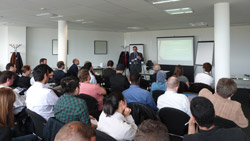
Along with AnyLogic Europe, we held a seminar for AnyLogic users in Paris. It was attended by 55 representatives from companies and universities that use simulation modeling for education and business purposes. The seminar’s speakers showcased how AnyLogic is applied in the fields of energy systems, industrial risk assessment, healthcare, logistics, and pedestrian flow modeling.
Introduction to AnyLogic Cloud How-To Video

AnyLogic 8 with AnyLogic Cloud allows you to upload your models to the Cloud. Once in the Cloud, you can run and access your models from a web browser on ANY device (tablet, phone, etc.). Plus, easily share models, discuss scenarios, and store models for future use. Check out one of our latest How-to videos that will walk you through a few easy steps, making it even simpler for you to take advantage of the AnyLogic Cloud.
Join Us at anyLogistix Seminar in Paris!

anyLogistix™ (ALX™), by AnyLogic Company is the supply chain analytics software to design, optimize and analyze your company’s supply chain. It combines powerful analytical optimization approaches together with innovative simulation technologies offering you a comprehensive set of tools for end-to-end supply chain analytics. What's new in anyLogistix 2.5?
Optimal Aircraft Boarding Strategy

To increase profit, airlines seek to minimize turnaround time. Turnaround time is attributed to multiple factors, disembarkation, baggage unloading, refueling, cargo unloading, aircraft maintenance, cargo and baggage loading and passenger boarding. A group in the Science and Engineering Faculty at Queensland University of Technology in Brisbane, Australia completed a project using AnyLogic software to investigate the turnaround time for aircraft passenger boarding using AnyLogic simulation software. The recently published paper studied seven common boarding strategies and two new suggested strategies to find the optimal boarding methods for a Boeing 777 and Airbus 380. They considered behavior of groups traveling together, and individuals storing luggage as part of the simulation model.
Modeling and Optimization of Unconventional Oil Production

Canada's oil reserves are third only to Venezuela and Saudi Arabia, and over 95% of these reserves are in the oil sands deposits in the province of Alberta. Oil sands are a deposit of loose sand or partially consolidated sandstone containing petroleum or other hydrocarbons which require in situ methods for production. The in situ method is more costly than the mining method, but it's much less damaging to the environment, requiring only a few hundred meters of land and a nearby water source to operate. It's estimated by the Alberta government that 70-80% of oil in the oil sands is buried too deep for open pit mining; therefore, in situ methods will likely be the future of extracting oil from oil sands. The most common form of in situ is called Steam Assisted Gravity Drainage (SAGD). With the SAGD technique, a pair of horizontal wells, situated 4 to 6 meters above the other, is drilled from a central well pad. In a plant nearby, water is transformed into steam which then travels through above-ground pipelines to the wells and enters the ground via a steam injection (top) well.