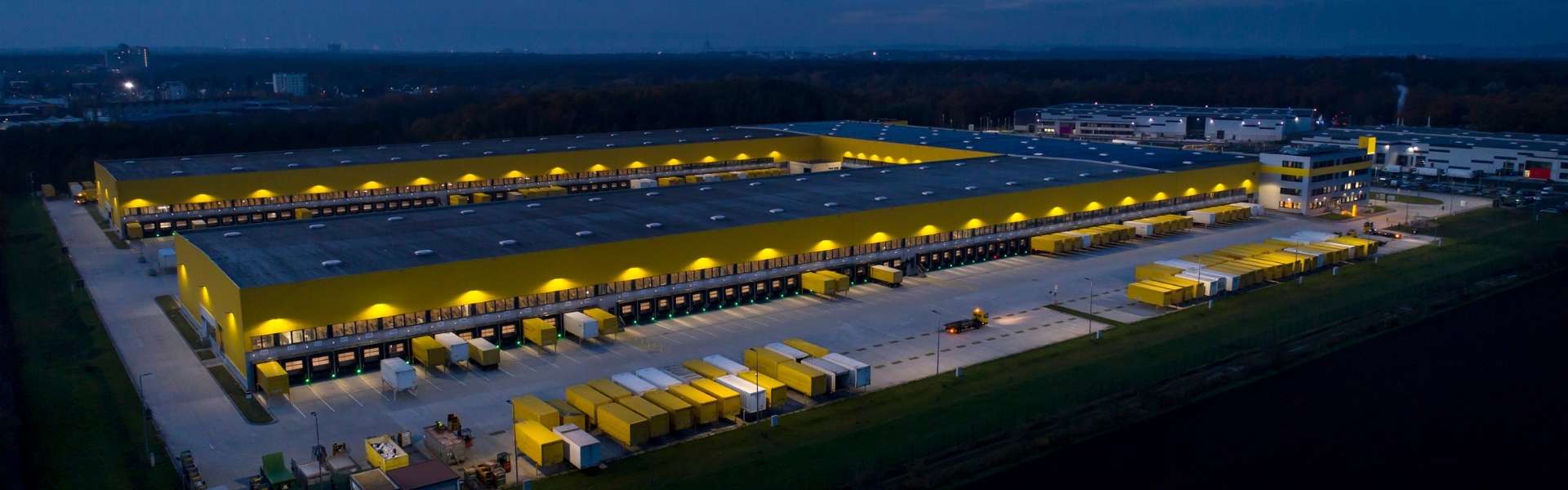

Problem:
DHL’s warehouse faced inefficiencies due to dispersed stock-keeping units (SKUs), long picker travel distances, and frequent pick-and-pass operations. These issues limited order-picking efficiency and made it difficult to test improvements without risking disruptions to daily warehouse operations.
Solution:
DHL developed a cloud-based warehouse simulation model using AnyLogic to model the entire outbound process, including unit and case picking, conveyors, and shipment sortation. The simulation model enabled data-driven scenario testing. It helped the team evaluate slotting strategies aimed at improving warehouse picking efficiency.
Results:
- Improved order-picking efficiency by reducing SKU dispersion and picker travel distances.
- Reduced pick-and-pass activity (main bottleneck) by 72%.
- Cut order turnaround time from 4 to 2 hours, doubling throughput.
- Provided visibility into key warehouse KPIs such as turnaround time, congestion, and resource utilization.
Introduction: warehouse operations at scale
Large-scale warehouse systems require careful coordination between picking, sorting, and material-handling processes. In large distribution centers, inefficient layout design, SKU placement, and operational workflows can significantly reduce order-picking efficiency, leading to longer order fulfillment times and increased labor costs.
This is especially critical because order picking is typically the most labor-intensive warehouse activity, accounting for up to 75% of total warehouse operating costs.
DHL, the world-leading logistics company, operates complex distribution networks where similar efficiency problems must be solved to maintain service levels and control costs.
Problem: low order-picking efficiency
In this case, one of DHL’s warehouse facilities covered approximately 50,000 square meters and managed around 70,000 active SKUs across 30,000 lines. Most order fulfillment activities occurred across three mezzanine levels, creating complex material flows and coordination challenges.
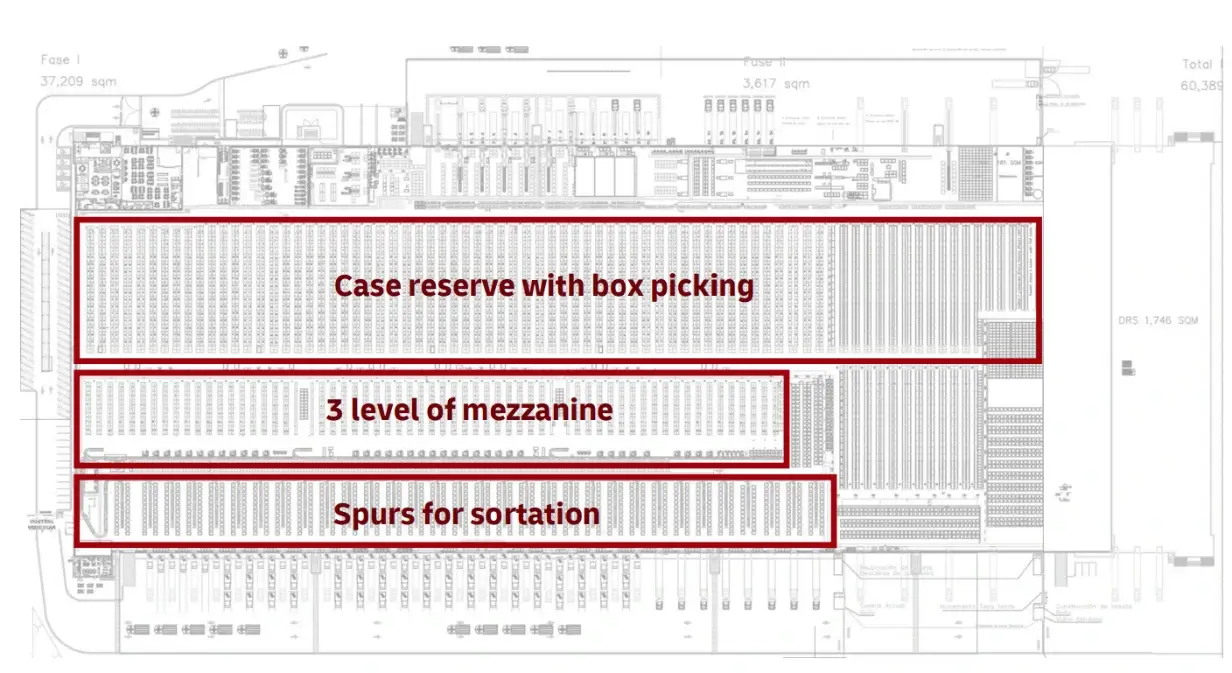
One of the main challenges was SKU dispersion across aisles, which increased picker travel distances and drove excessive pick-and-pass activity between mezzanine levels. This affected turnaround time and created additional pressure on the conveyor and sortation processes.
Moreover, without a reliable way to test operational scenarios in advance, implementing improvements involved significant uncertainty and operational risk.
Solution: warehouse test environment in AnyLogic
To support operational optimization, DHL developed a detailed simulation model of the warehouse using AnyLogic and its ready-to-use Material Handling library.
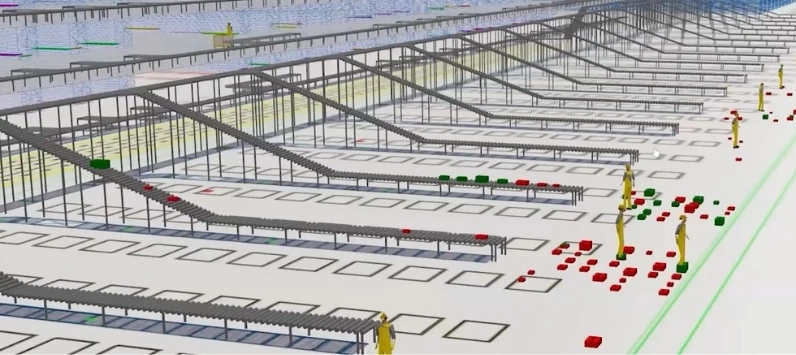
The model replicated the entire outbound workflow and served as a decision-making tool, enabling teams to analyze how operational changes impact performance and order-picking efficiency. The simulation model included key warehouse processes:
- Unit picking from mezzanine levels.
- Full-case picking from reserve racks.
- Pick-and-pass consolidation processes.
- Conveyor and carton flow tracking.
- Shipment sortation through multiple spurs.
- Dynamic resource allocation for operators.
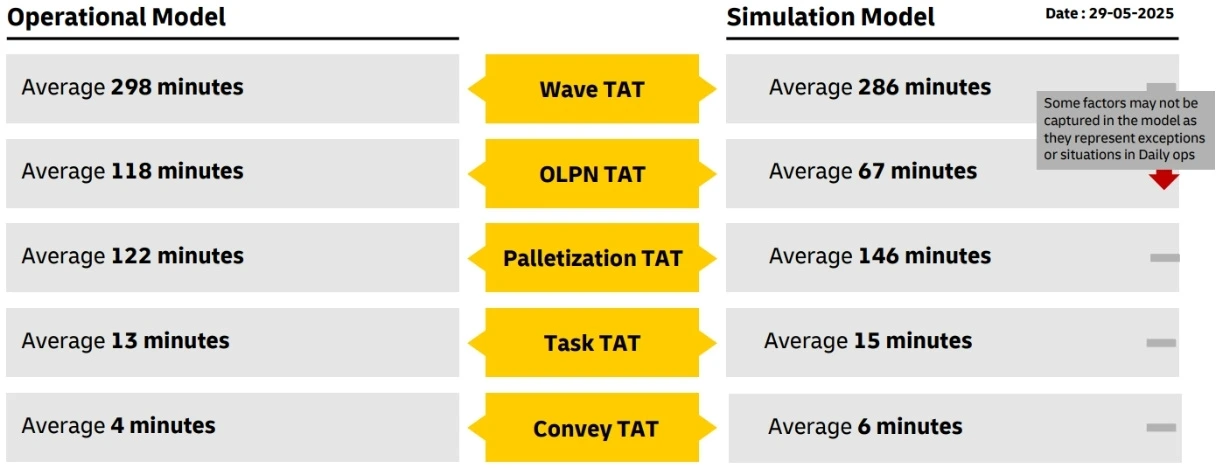
To ensure reliability, the model was validated against real operational data from the warehouse. Key performance indicators such as turnaround times (TAT) for waves, order lines (OLPN), palletization, and conveyor processes were compared between the operational model and simulation outputs.
The validation results showed a close alignment for all metrics. It confirmed that the simulation model was sufficiently accurate to support scenario testing and decision-making for warehouse optimization initiatives.
One of the main uses of the simulation model was slotting optimization. By testing different SKU placement strategies, the operations team could evaluate how product location affected picker travel distance and order fulfillment time.
The simulation used historical data to recreate daily warehouse operations with high accuracy. This allowed the team to test strategies for improving warehouse picking efficiency, including SKU slotting adjustments and workflow changes.
The simulation model was deployed on AnyLogic Cloud, providing a user-friendly interface. Operations managers could upload input data, configure parameters, and run experiments. Within minutes, the system generated performance results and visual dashboards displaying key operational metrics.
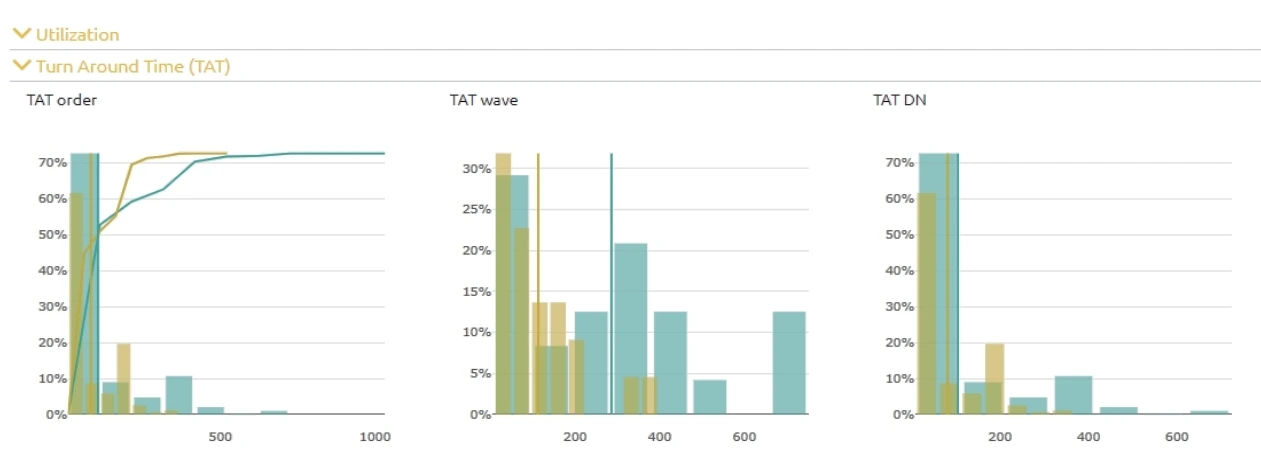
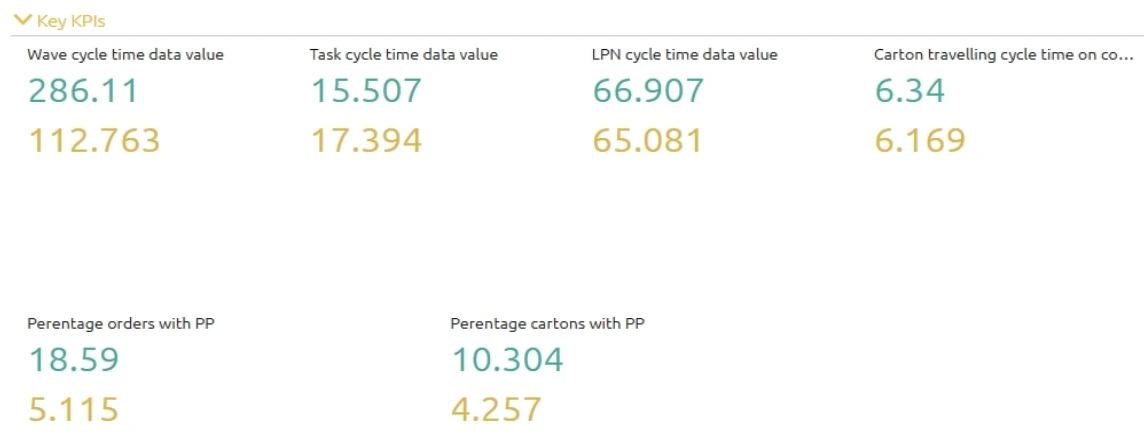
To measure the impact of operational changes, the simulation model tracked several critical KPIs:
- Turnaround time for waves, orders, and shipments.
- Congestion levels in conveyor systems and sortation areas.
- Resource utilization for pickers and operators.
These metrics helped identify bottlenecks that reduced order-picking efficiency and provided actionable insights for process optimization.
Discover another DHL project aimed at warehouse cluster pick optimization. In this case study, learn how the world’s leading logistics company achieved a 35% reduction in cart congestion in one of its facilities.
Results: scalable framework for continuous optimization
By enabling scenario analysis, the simulation model helped the operations team identify strategies for improving warehouse picking efficiency, particularly through optimized SKU slotting. By placing SKUs that are frequently picked together closer to each other, the warehouse reduced the average number of aisles visited per order from 2.08 to 1.78, directly lowering picker travel time.
The main performance improvement came from reducing pick-and-pass activity, which had been identified as the primary source of inefficiency in the operation. By reducing SKU dispersion, the number of pick-and-pass operations decreased significantly, resulting in a 72% reduction in pick-and-pass orders.
Most importantly, overall operational efficiency improved at the system level. The order turnaround time was reduced from 4 hours to 2 hours, effectively doubling throughput capability for the tested scenario.
Overall, the warehouse simulation model provided a scalable framework for continuously optimizing warehouse processes and improving order-picking efficiency through simulation-driven decision support.
The case study was presented by Ankit Kumar from DHL at the AnyLogic Conference 2025.
The slides are available as a PDF.