
Problem:
Rumo needed to evaluate the performance and future capacity of a highly complex railway system with stochastic train arrivals, route conflicts, wagon blocking operations, and shared infrastructure.
Solution:
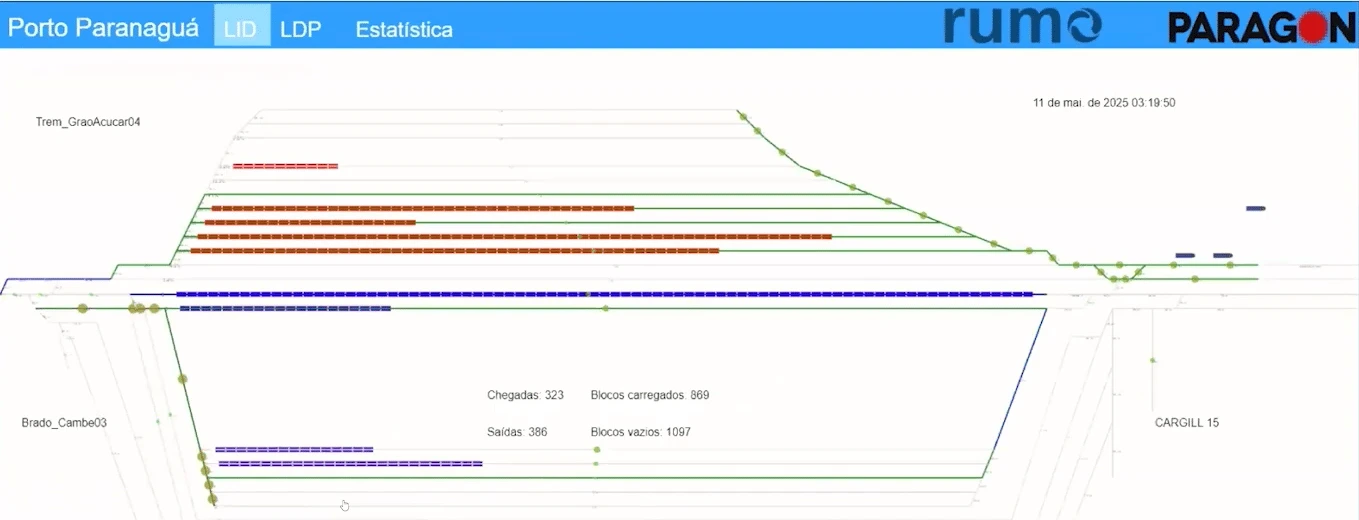
Paragon developed a dynamic simulation model in AnyLogic representing the railway logistics process inside the port of Paranaguá. The model integrated Excel-based scenario management, configurable rail layouts, route reservation logic, KPI tracking, and parallel scenario execution to support flexible operational and strategic analysis.
Results:
- Identified bottlenecks, route conflicts, and railway capacity constraints before implementation.
- Accelerated strategic analysis through parallel scenario execution and replication management.
- Supported collaborative decision-making for long-term railway and port expansion planning.
Introduction: railway infrastructure at the core of port operations
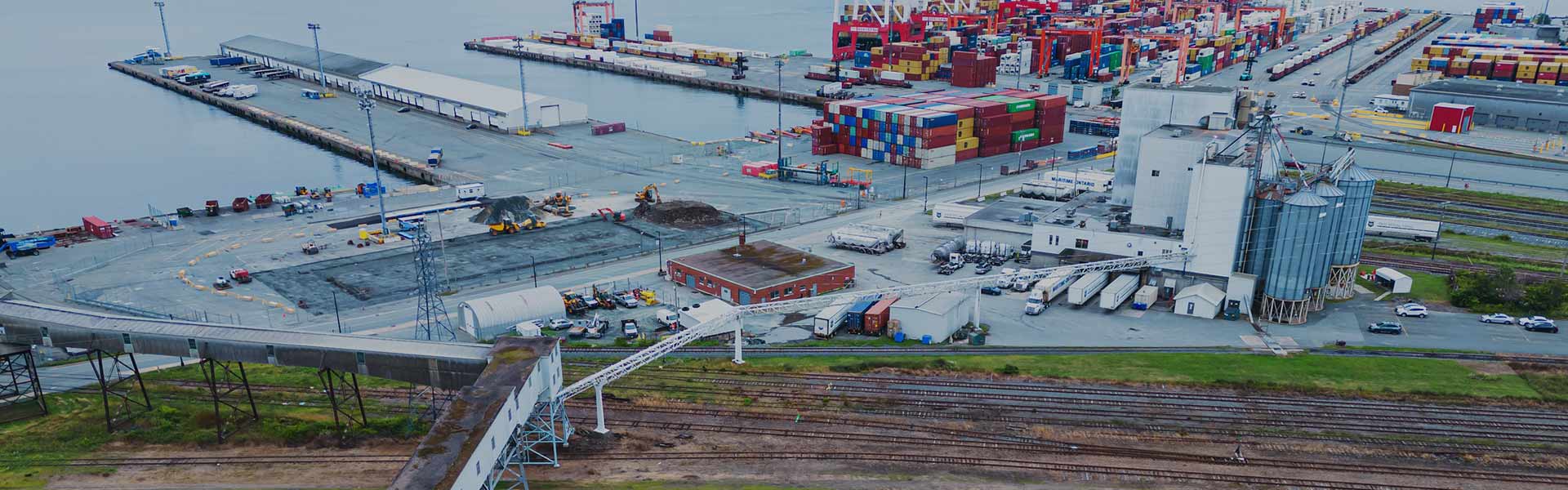
Brazil is one of the world’s largest exporters of agricultural commodities, and its ports play a critical role in global grain and sugar supply chains. Among them, the Port of Paranaguá stands out as one of Latin America’s most important bulk cargo gateways. It handles more than 21 million tons of grain and sugar exports annually and ranks as Brazil’s second-largest port for these commodities.
At the same time, growing export demand, terminal expansion projects, and new quay developments are placing increasing pressure on the railway infrastructure that feeds the port.
Problem: a highly complex stochastic system
Rumo, the largest railway operator in the country, is responsible for managing the rail network within the Port of Paranaguá. Every day, trains arriving from Rumo’s network come over different routes. Overall, operations within the port railway complex involve many interdependent activities, such as:
- Train reception and yard management.
- Wagon handling and terminal servicing.
- Network routing and outbound assembly.
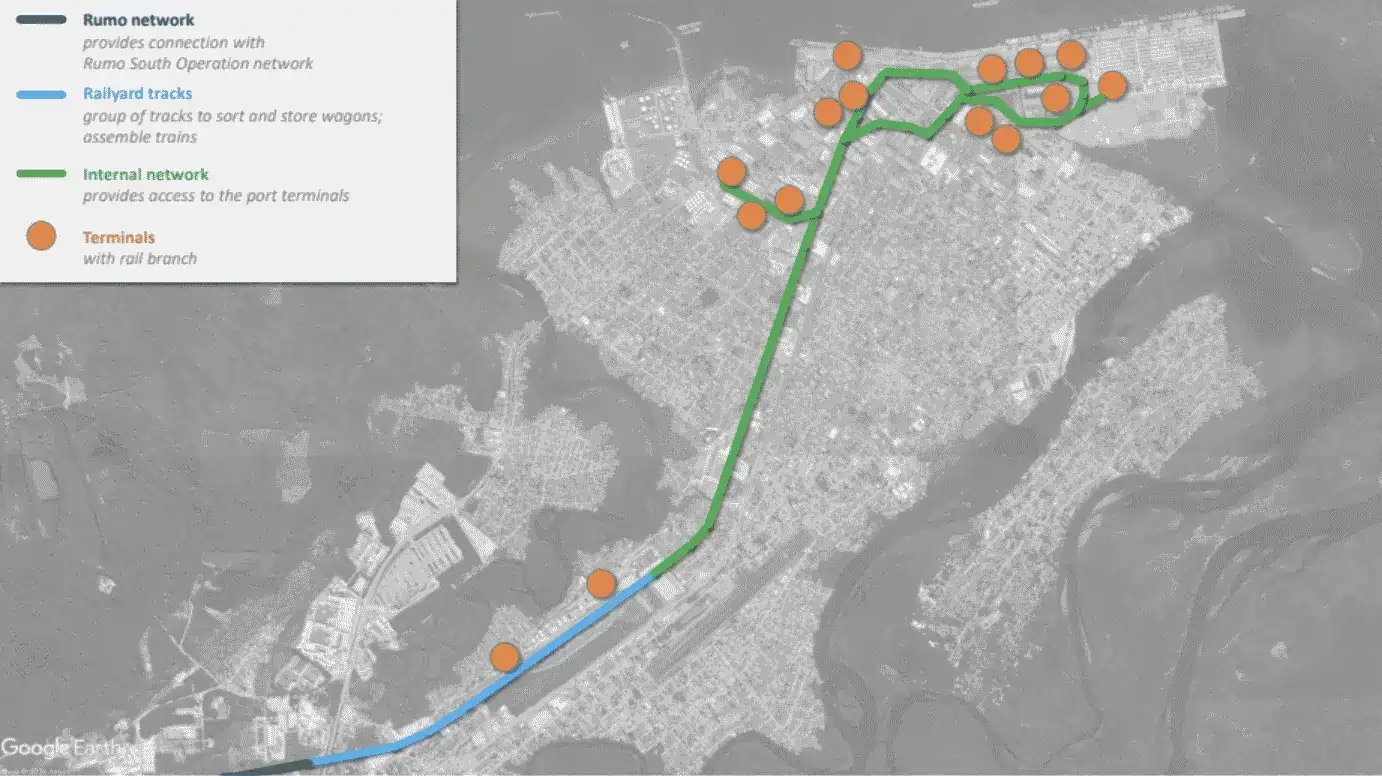
These activities create a highly stochastic system where train arrivals, wagon distributions, route availability, and terminal capacities continuously interact. Small variations in these factors can quickly spread across the system, creating operational bottlenecks.
Traditional analytical tools could no longer capture operational variability and resource conflicts affecting system performance.
Rumo needed a solution capable of:
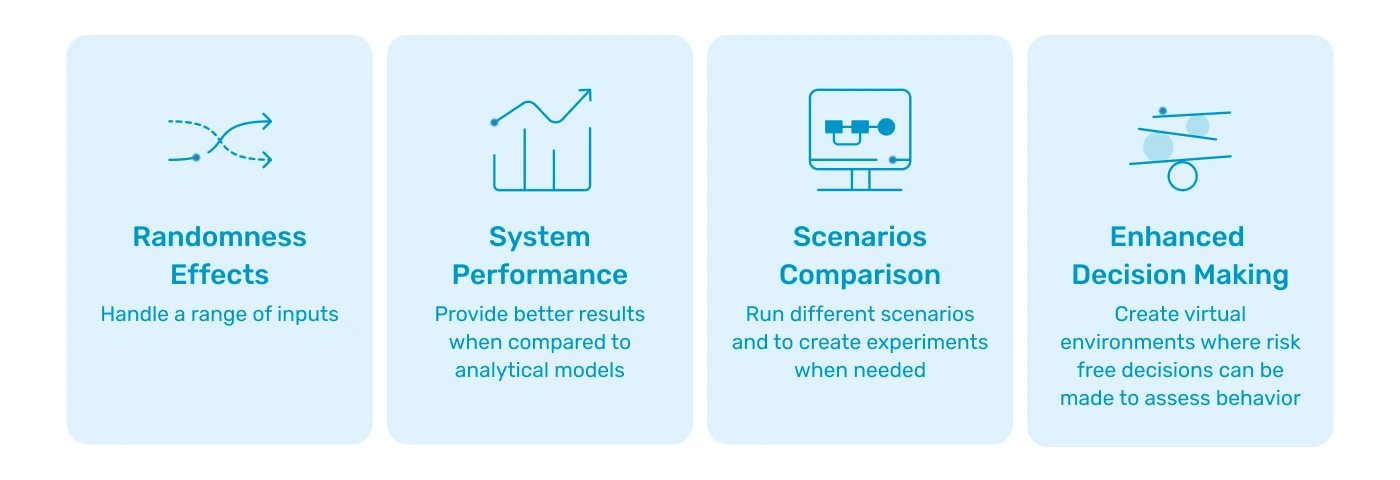
- Dealing with randomness effects.
- Evaluating current system performance.
- Testing future infrastructure and operational scenarios.
- Supporting collaborative decision-making between technical and operational teams.
Solution: dynamic simulation model
Rumo partnered with Paragon, a consulting firm specializing in decision-making. Together, they decided to use simulation technology to address the needs of the port railway system. They developed a dynamic railway simulation model in AnyLogic that represented the full rail logistics process inside the Port of Paranaguá.
The consulting company used Process Modeling Library elements to create a flexible and scalable simulation, focused on the following activities:
- Cargo throughput.
- Dwell time (time spent by wagons in the port).
- Tracks utilization.
- Shunting locomotives utilization.
- Trains dispatched.
One of the most complex modeling tasks was representing train arrival and dispatch logic, especially because wagon blocks could not always be split freely. The model had to respect operational rules around train composition and wagon separation.
The key design objective of the model was flexibility. Instead of creating a static network layout, Paragon modeled track segments as configurable agents that were dynamically generated from Excel-based layout definitions. This dynamic simulation approach allowed users to modify the railway topology, routes, and infrastructure without changing the simulation code itself.
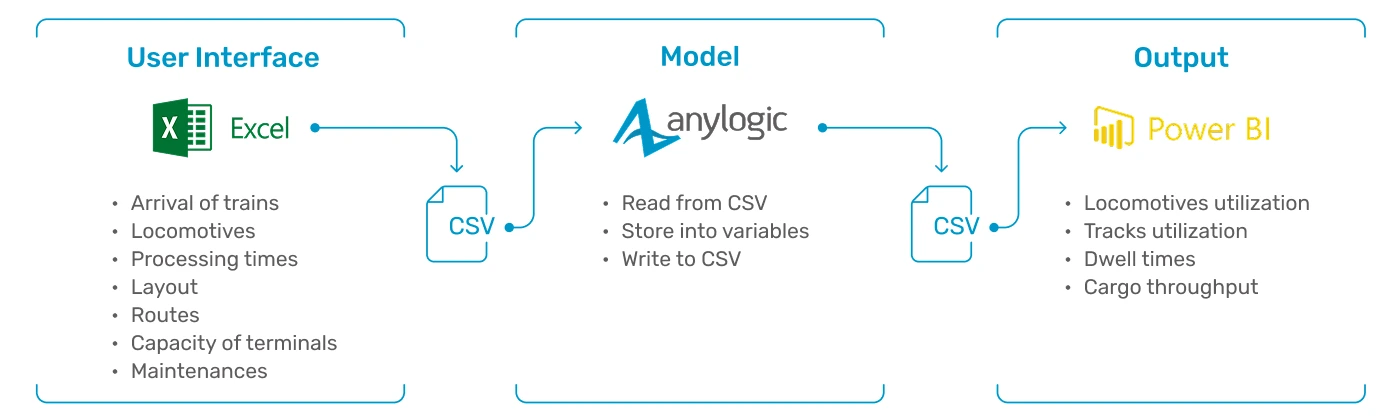
The project also focused on usability for operational teams. Input data was managed through Excel spreadsheets containing train schedules, locomotive counts, processing times, layouts, routes, terminal capacities, and maintenance parameters.
Spreadsheets were converted to CSV files, which were read directly in AnyLogic. Simulation outputs could be exported back to CSV for further visualization and analysis in Power BI.
To accelerate analysis, the team implemented functionality for queuing and running multiple scenarios and replications in parallel. Users could configure batches of scenarios, execute them simultaneously, and compare results efficiently across alternative investment or operational strategies.
Results: a risk-free decision support environment
The dynamic simulation model provided Rumo with a test environment capable of evaluating both operational and long-term strategic questions. This model was intentionally designed as a collaborative planning tool. This decision ensured that operational teams could understand, interpret, and apply the simulation results in real-world railway operations. Using defined KPIs, stakeholders could compare scenarios and identify bottlenecks, resource conflicts, and infrastructure limitations before making investment decisions.
The project delivered several important benefits:
- Improved visibility into complex railway interactions.
- Accelerated evaluation of infrastructure expansion scenarios.
- Ensured flexible configuration of layouts and operational rules.
- Optimized management of scenarios and replication execution.
- Enhanced collaboration between simulation specialists and operational teams.
Read another case study from Rumo to find out how the company makes informed decisions on train types, routing, and network expansion with the help of simulation.
The team also identified several opportunities for future model expansion, including:
- Integration with broader Rumo railway network models.
- More detailed terminal process modeling beyond black-box representations.
- Inclusion of truck unloading operations to evaluate multimodal interactions.
- Expanded analysis of rail-road coordination and capacity impacts.
The case study was presented by Luiz Gustavo Schmitt and Vinícius Freitas at the AnyLogic Conference 2025.
The slides are available as a PDF.