
Problem:
With ever-increasing urbanization, metro stations are experiencing growing passenger congestion, impacting operational efficiency and passenger safety.
Solution:
STAM implemented a digital twin of one of Genoa’s main metro stations. A highly detailed model provided intuitive 2D and 3D visualizations. Additionally, crowd management technology displayed passenger flow density, congestion hotspots, and key operational metrics.
Results:
The innovative example of a digital twin of the metro station demonstrated significant benefits:
- Improved operational efficiency
- Enhanced passenger experience
- Introduced dynamic service adaptation
Introduction: research of a metro digital twin
Public transportation plays a crucial role in modern urban mobility, especially in densely populated areas where efficient metro systems are essential for smooth and safe passenger movement.
STAM, an engineering and technology consulting company based in Genoa, Italy, specializes in multidisciplinary and cross-sectoral solutions. They work across various industries, including urban transportation projects that align with the Mobility as a Service (MaaS) concept for smart city integration.
Their research project aimed to enhance metro station efficiency by developing a digital twin, integrated with artificial intelligence (AI) for predictive analytics and crowd management technology.
Problem: managing real-time passenger flow to avoid congestion
With ever-increasing urbanization, metro stations are experiencing growing passenger congestion, impacting operational efficiency and passenger safety. This project, initiated during the COVID-19 pandemic, sought to support public transport operators by optimizing service levels, enhancing safety, and reducing infection risks. The key challenges included:
- Managing real-time passenger flow within a metro station.
- Predicting congestion patterns and mitigating overcrowding risks.
- Enhancing service reliability by dynamically adjusting train schedules.
Solution: a digital twin integrated with live data feeds
To address these challenges, STAM implemented a digital twin of one of Genoa’s main metro stations. A highly detailed model provided intuitive 2D and 3D visualizations, displayed crowd density, congestion hotspots, and key operational metrics.
The example of the digital twin integrated live data feeds from sensors and cameras installed within the metro station. The communication between these sensors and AnyLogic simulation software was facilitated through the development of a WebSocket and the use of AnyLogic Cloud APIs.

This real-time data stream ensured that the virtual environment accurately reflected the station’s current state, allowing operators to monitor crowd dynamics and operational performance. Based on the data collected by sensors, the model dynamically input agents, representing pedestrians and trains, to mirror real-world conditions.
The crowd management technology enabled operators to oversee station conditions as they evolved. In addition, it automatically alerted operators to take timely corrective actions to mitigate potential disruptions.
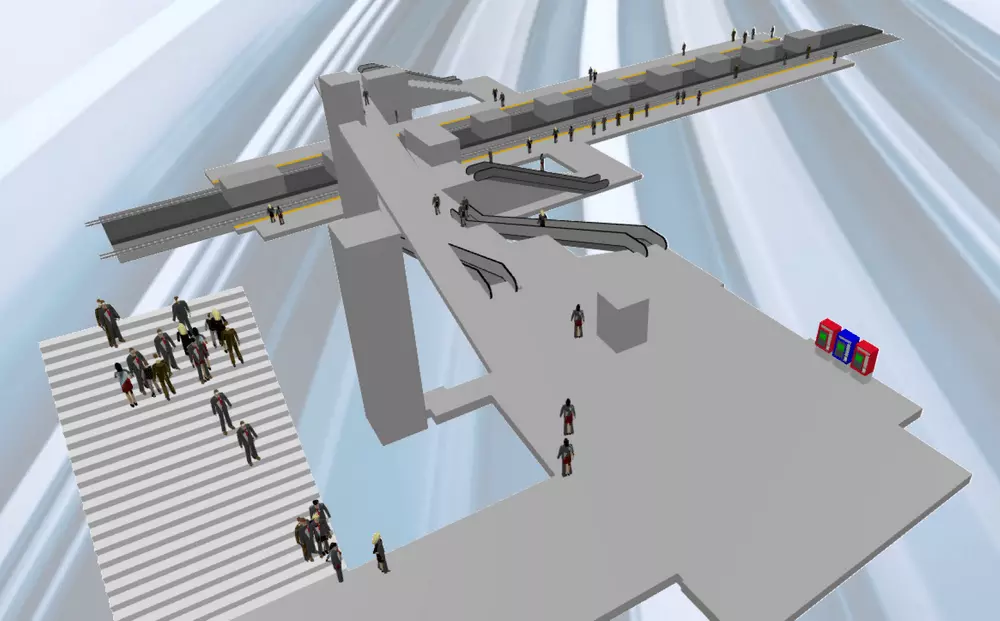
Beyond real-time monitoring, the digital twin included a predictive engine leveraging historical data and explainable AI techniques. Predictive simulations allowed users to generate optimistic and pessimistic scenarios, assessing potential crowding levels and congestion under different conditions.
Additionally, the system enabled users to conduct what-if scenario analyses, adjusting factors such as passenger flows and infrastructure utilization to explore the impact of various hypothetical situations.

To implement the example of the digital twin, STAM selected AnyLogic simulation software because of its flexibility to create a highly detailed and dynamic simulation of metro passenger flows. AnyLogic’s advanced simulation and crowd management technology, including both 2D and 3D representations, provided clear and insightful views of crowd movements and congestion points within the station.
Additionally, the software’s seamless integration with real-time data sources through AnyLogic Cloud APIs ensured that the digital twin could continuously reflect current operating conditions. The scalability and flexibility of AnyLogic made it the ideal choice for handling complex simulations involving dynamic passenger behaviors and unpredictable demand patterns.
Read also: Explore additional resources on the use of crowd and passenger simulation software.
Results: improved operational efficiency and passenger experience
Using AnyLogic’s simulation capabilities, STAM successfully developed an innovative example of a digital twin solution for metro station optimization. The project demonstrated significant benefits:
- Improved operational efficiency: Crowd management technology with the digital twin enabled better passenger management, reducing waiting times and optimizing train scheduling.
- Enhanced passenger experience: Real-time monitoring and predictive insights improved safety, comfort, and overall service quality.
- Dynamic service adaptation: The system facilitated demand-driven scheduling, particularly beneficial for autonomous metro systems.
Future developments
STAM aims to further enhance the digital twin’s capabilities with:
- Autonomous demand-based train scheduling: to dynamically adjust the frequency of trains based on real-time passenger demand.
- Emergency response planning: to integrate predictive insights and improve safety measures.
- Sustainable transportation initiatives: to align with the Mobility as a Service (MaaS) concept for smart city integration.
By integrating the latest crowd management technology, STAM is setting a new benchmark for digital twins in the transportation sector.
The case study was presented by Pietro De Vito from STAM at the AnyLogic Conference 2024.
The slides are available as a PDF.