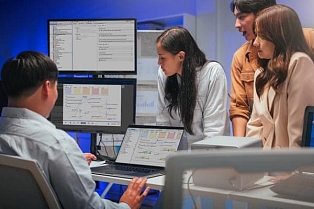
At the AnyLogic Conference 2025, simulation experts, industry leaders, and tech innovators gathered for an in-depth look at how simulation drives efficiency, strategy, and innovation across industries. From aerospace and pharma to e-commerce, attendees explored how AnyLogic enables organizations to model complex systems and prepare for the future.
Let’s take a look at some highlights from this year’s event, including product presentations and some of the most notable case studies.
Contents:
- Presentations from leading companies
- AnyLogic 8: newest features and roadmap
- AnyLogic Cloud: towards a full-cycle ecosystem for simulation
- AI and simulation: AnyLogic’s research and development
- AnyLogic 9: the future of simulation modeling
- Workshop on supercharging model development
- A celebration of innovation
Presentations from leading companies and tech innovators across industries
This year’s Conference featured 21 insightful presentations from industry leaders. Viewers who joined us learned how companies model complex systems and prepare for future challenges. Below, we highlight some of the world-class examples shared during the event.
Airbus: a scalable co-simulation framework

Airbus India introduced a co-simulation framework that enables multiple models to run simultaneously while securely exchanging data. Using AnyLogic’s Java environment and encapsulated black-box models, the framework supports real-time analysis of complex ecosystems, including supply chains and manufacturing.
The Airbus team demonstrated how time synchronization and two-way communication allow models of varying complexity to interact effectively while delivering actionable insights. In addition, the implementation of a “black-box” approach to the modeling process ensured secure data exchange in cross-organizational collaboration.
AstraZeneca: engineering the antifragile supply chain

AstraZeneca, in partnership with Decision Lab, showcased a strategic digital twin designed to build an antifragile supply chain. The introduction of a three-model simulation framework enabled probabilistic scenario planning, allowing management to evaluate investment strategies under uncertainty. Visual, interactive dashboards and side-by-side scenario comparisons fostered cross-functional alignment and a data-driven approach.
By replacing slow, error-prone Excel workflows, the team enhanced agility, transparency, and strategic foresight, supporting long-term decisions and mitigating risk in critical manufacturing and supply chain investments.
Amazon: network science for facility design

Amazon presented how network science and simulation optimize fulfillment facilities worldwide. Using AnyLogic alongside internal tools, the team modeled material flow, transportation, and facility layouts to balance safety, speed, cost, and sustainability.
The focus was on outbound containerization strategies, where 3D bin-packing simulations quantified trade-offs between fluid and palletized loading. The experts revealed hybrid strategies that preserve safety and operational consistency while minimizing the number of trailers.
DHL: a digital twin for smarter warehousing

DHL showcased the Warehouse Simulator, a large-scale digital twin that models picking, replenishment, and outbound sorting within a facility. This digital twin captures detailed operational logic, validates KPIs against real-world performance, and enables scenario testing such as slotting optimization, reducing travel distances, and improving turnaround times.
This project once more demonstrated how digital twins drive data-driven decision-making, efficiency improvements, and process optimization at scale.
AlsanX: simulation, AI-powered reporting, and visualization via Omniverse

AlsanX demonstrated the power of digital twins as actionable operational tools in industrial plants. Their work integrated simulation, AI, virtual reality (VR), and optimization to create dynamic digital ecosystems. A steel industry case study illustrated the value of digital twins in optimizing scheduling, energy efficiency, and maintenance.
Building on AnyLogic’s NVIDIA Omniverse integration, the team showed how advanced simulation and visualization are converging into practical, next-generation digital twins that support both operational efficiency and environmental sustainability.
These are just some of the presentations from this year. If you missed them or want to revisit a particular presentation, you can find all the materials and video recordings on the Conference page.
AnyLogic 8: newest features and roadmap
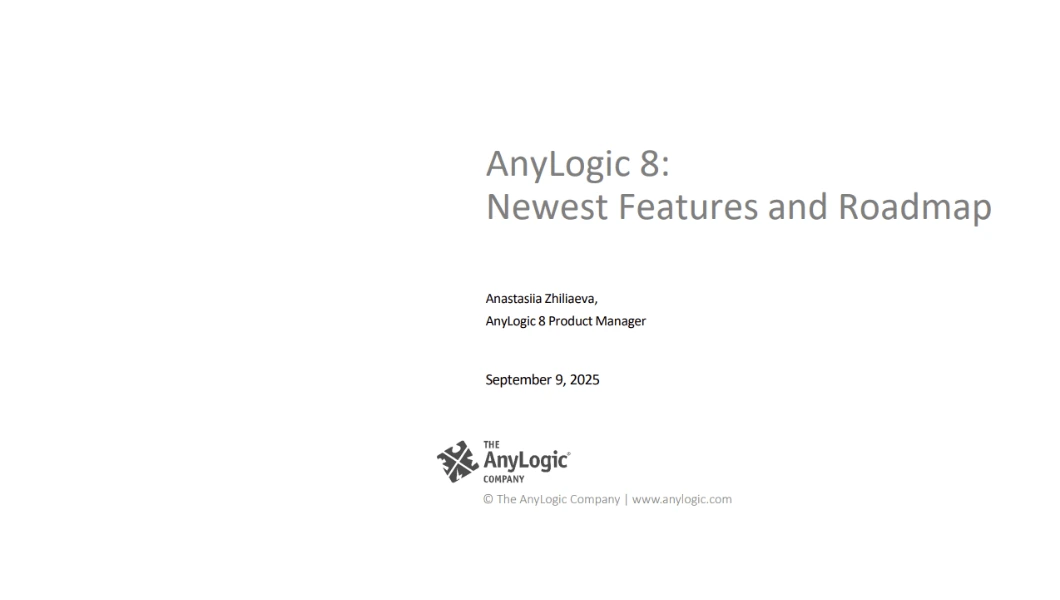
Anastasia Zhiliaeva, AnyLogic 8 Product Owner, presented an overview of the five product releases introduced since the last Conference. These brought improvements in model performance, usability, visualization, and automation.
For example, the new Model Profiler helps users pinpoint performance bottlenecks. Enhancements like folders and a favorites panel improve organization for extensive projects. The Chart Wizard, introduced in AnyLogic 8.9.6, now automates chart creation, streamlining analytics. Anastasia also highlighted the Material Handling Library, which saw major upgrades over the past year.
Anastasia concluded with a roadmap outlining updates that users can expect in the future, such as 3D preview in design time, inspect window customization, new 3D formats support, markup creation using scripting, and much more.
For more details on the newest and upcoming features, watch the video from the Conference below. You can also explore previous release blogs and videos.
AnyLogic Cloud: towards a full-cycle ecosystem for simulation
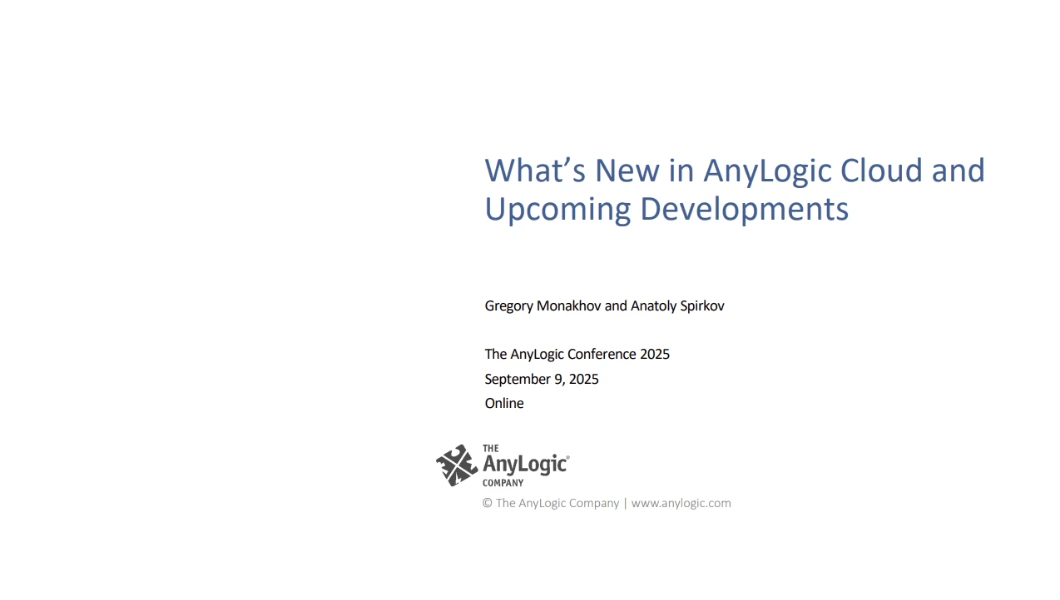
The product team presented the evolving vision of AnyLogic Cloud: to transform it from a model-run environment into a full-cycle platform that unifies model development, deployment, and collaboration.
The team showcased a traffic-intersection pilot project, demonstrating some of the most requested features, including on-premises hosting, two-factor authentication, custom branding, and external system integration. The model illustrated optimization experiments, real-time debugging, and automated Excel reporting, reflecting the platform’s enterprise-level capabilities.
AnyLogic Cloud is transforming into a secure, scalable, and fully integrated simulation ecosystem, bridging model creation and execution while empowering enterprise-wide collaboration and data-driven decision-making. For more details, check out the example project in the video below.
AI and Simulation: AnyLogic’s research and development
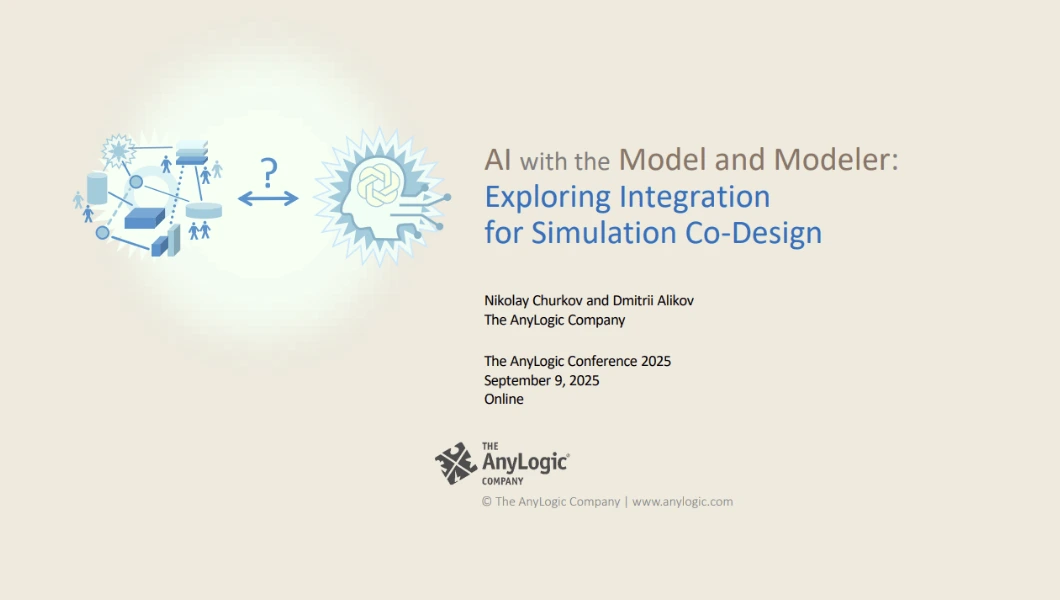
The AnyLogic team showcased their R&D on integrating large language models (LLMs) with simulation. They demonstrated how GPT-5 can generate working models using an extended Python API.
The emergence of LLMs marks a paradigm shift, providing more accessible and flexible AI assistance. LLMs are not just coding helpers—they have the potential to automate conceptualization, routine tasks, and model improvement.
Despite AI’s capabilities, the need for human oversight remains paramount. Trust issues arise because AI-generated models must be verified for accuracy. Humans will continue to play a crucial role in inspecting models, validating assumptions, and making judgment calls. This hybrid approach strikes a balance between the efficiency of AI and the expertise of humans. Explore more in the video below.
AnyLogic 9: the future of simulation modeling
The transition from project-based simulation models to digital twins signifies a shift in how simulations contribute to business processes. This evolution requires a platform that supports continuous use, integrates with operational data, and ensures high reliability, transforming simulation from a one-off project deliverable into a strategic tool.
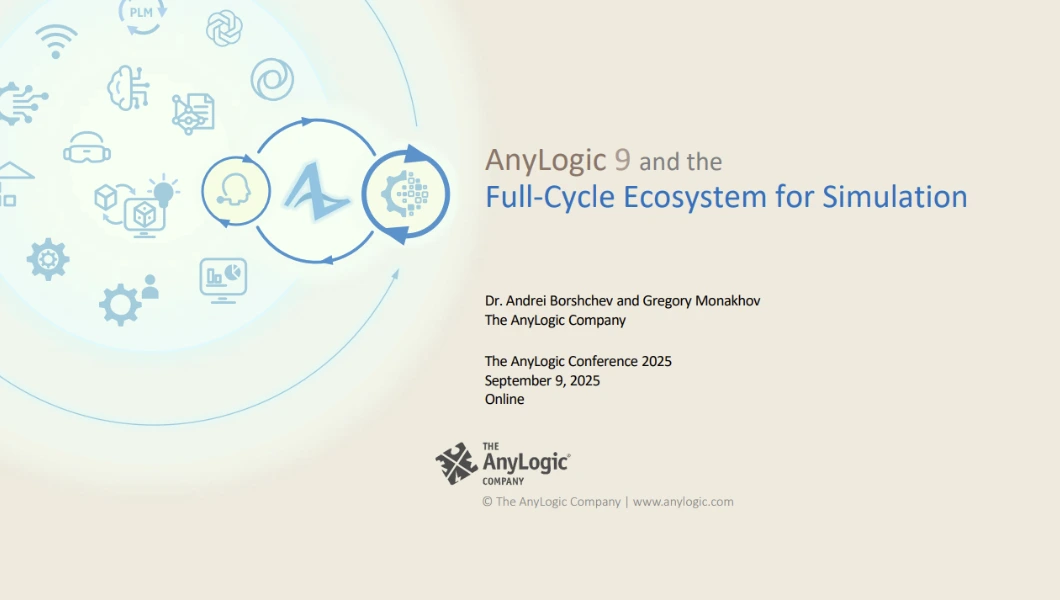
Andrei Borshchev and Gregory Monakhov presented AnyLogic 9, the next step toward a unified and collaborative simulation environment. In the demo, they showcased the AnyLogic 9 workspace, already available libraries (Fluid, Traffic, Rail), a built-in database for dynamic data inputs, and powerful search and refactoring tools.
They also highlighted ongoing improvements in user interface consistency, performance, and upcoming features such as system dynamics, the Material Handling Library, state charts, Git integration, and more. Watch the video below to see AnyLogic 9 in action.
Workshop on supercharging model development
In a dedicated workshop, Dr. Benjamin Schumann, a simulation modeling guru with over 15 years of experience, encouraged modelers to think like toolmakers by creating reusable utilities and frameworks to enhance modeling efficiency. He demonstrated practical techniques such as trace-line debugging, sanity checks, and abstract utility agents for shared functions.
Ben also showed how to build a lightweight custom unit testing framework and publish JavaDoc documentation for personal libraries, promoting better code quality and collaboration.
If you missed this workshop live, make sure to catch up by watching the video.

The AnyLogic Conference: a celebration of innovation
This year’s event celebrated innovation in simulation modeling. Together, we explored cutting-edge applications, heard visionary presentations, and uncovered real-world strategies shaping the future of simulation.
We would like to once again thank all the presenters for sharing their expertise, our engaged audience for your curiosity and participation, and everyone who contributed to making this event a success.
We look forward to welcoming you back to next year’s conference, where we’ll share even more breakthroughs, practical applications, and expert insights!
Be sure to subscribe to our monthly newsletter to stay up to date on new blog posts, upcoming events, and the Model of the Month.